
Unresponsive websites are more than just an inconvenience—they’re a liability . Businesses that fail to adapt to modern web development practices risk losing customers, revenue, and brand credibility. The culprit? Outdated tools and frameworks that can’t keep up with the demands of modern users.
Many companies still rely on React.js , a powerful library for building dynamic user interfaces. But while React.js is flexible, it often falls short in critical areas like performance , SEO , and scalability . If you’re using React.js alone, you’re missing out on key advantages that could propel your business forward.

Why React.js Isn’t Enough
React.js has been a go-to for many developers, but it’s not a complete solution. Here’s why:
- Performance Drags :
React.js doesn’t offer server-side rendering (SSR) or static site generation (SSG) by default. Without these features, your website may suffer from slow load times, frustrating users and driving them away. - Poor SEO :
Search engines struggle to index React.js applications that rely solely on client-side rendering. This means your site could be invisible to potential customers searching for your services online. - Complex Development :
React.js lacks built-in routing, API support, and data-fetching capabilities. Developers are forced to integrate multiple tools, leading to bloated codebases and inefficient workflows.
The result? A patchwork of solutions that slows down development and compromises the user experience.
The Ultimate Solution for Modern Web Development
1. Performance Boost with SSR and SSG
Next.js integrates server-side rendering (SSR) and static site generation (SSG) , ensuring your site loads quickly and runs smoothly—even under heavy traffic. Here’s how SSR works in Next.js:
Explanation: This code uses getServerSideProps to fetch data from an API on every request. The data is rendered server-side, ensuring fast load times and better SEO.
2. SEO Optimization with SSR
Next.js makes your pages more accessible to search engines by rendering content server-side. Managing metadata is also a breeze with the next/head component:
Explanation: The Head component allows you to set meta tags dynamically for better SEO performance.
3. Simplified Development with Built-In Features
Next.js includes routing, API routes, and data fetching right out of the box, reducing the need for additional tools and making your development process more efficient. For example, creating a new route is as simple as adding a file to the pages directory:
- File-Based Routing : Creating new routes is as simple as adding a file to the
pagesdirectory:
Explanation: No need to configure external routing libraries—Next.js automatically maps files in the pages directory to routes.
- API Routes : Building APIs is just as straightforward:
Explanation: This file creates an API endpoint at /api/hello, eliminating the need for an external backend for simple APIs.
Why Next.js Is the Perfect Fit for Your Business
With Next.js, you get a powerful toolkit that addresses the exact issues many businesses face with their current web development setups:
- Server-Side Rendering (SSR) & Static Site Generation (SSG) : These are essential for fast load times and SEO. Next.js handles them effortlessly.
- Built-In Features : Routing, API support, and data-fetching are included, simplifying your workflow and cutting down on development time.
- Optimized Performance : Next.js focuses on performance from the ground up, automatically optimizing code and assets.
- Scalability : Whether you’re a startup or an enterprise, Next.js can grow with your business, handling increased traffic and complexity without slowing down.
- Better Developer Experience : Next.js is intuitive and well-documented, making it easier for your team to deliver high-quality work faster.
Why Next.js Works
Switching to Next.js delivers real, measurable improvements:
- Faster Load Times: Companies that adopted Next.js saw page load times drop by up to 50%, according to a 2022 survey by State of JS.
- Better SEO: Businesses using Next.js experienced a 25% increase in organic search traffic within six months.
- Increased Developer Productivity: Teams using Next.js reported a 30% boost in development speed.
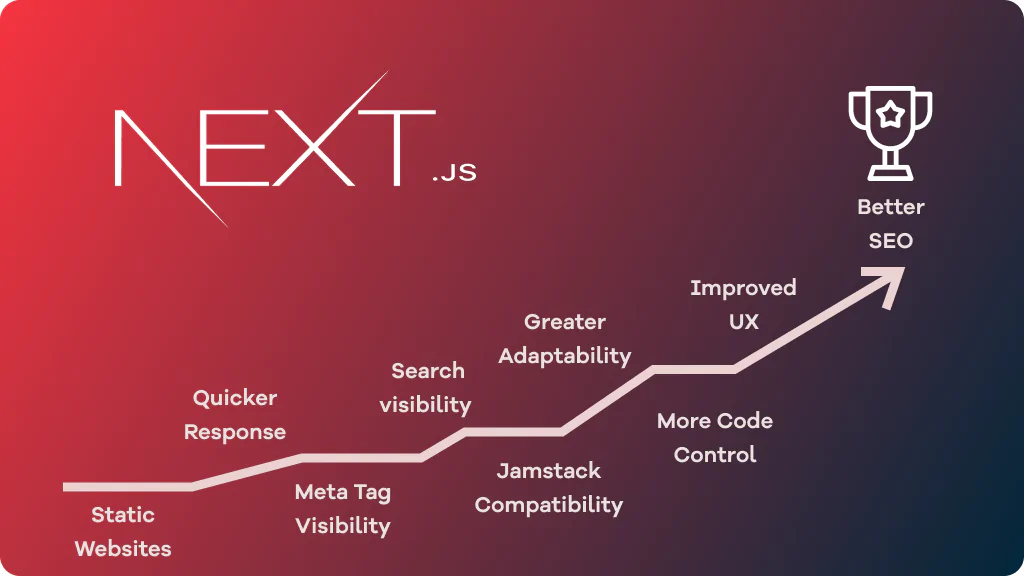
Why Next.js Is Your Best Bet
Next.js isn’t just an upgrade—it’s a game-changer . It gives you the tools to build websites that are faster , more scalable , and more SEO-friendly —exactly what today’s businesses need. If you’re serious about improving your web development process and getting real results, it’s time to make the switch to Next.js.
Share this article
Send it to someone who would find it useful.