
Most marketing struggles for the same reason: It asks for attention before it earns trust.
That is a bad trade in a crowded market.
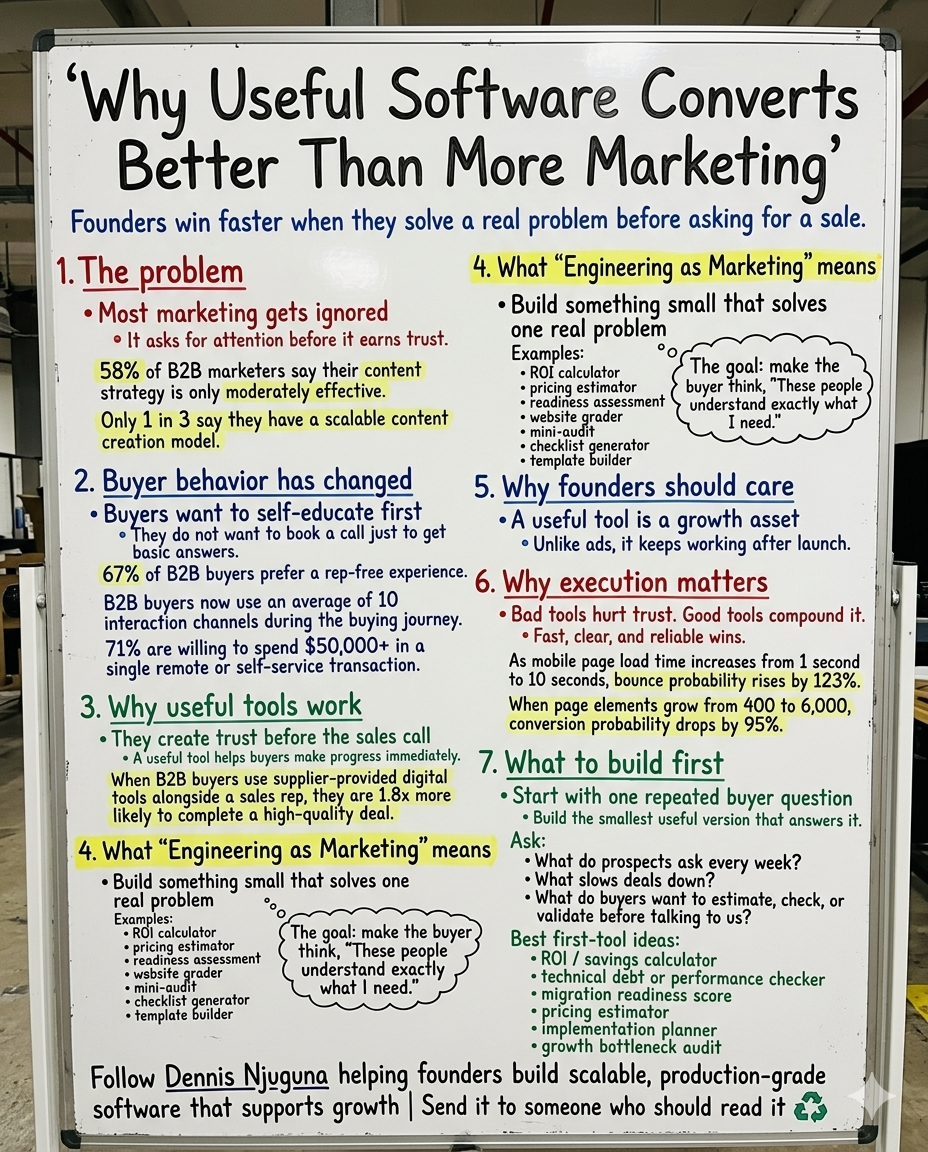
And the data backs it up. In Content Marketing Institute’s 2025 B2B benchmarks, 58% of marketers rated their content strategy as only “moderately effective,” only one in three said they had a scalable content creation model, 54% said lack of resources was their biggest non-creation challenge, 47% said measuring results was a major issue, and 45% said aligning content to the buyer journey was still a problem. That is not a volume problem. It is a relevance, clarity, and usefulness problem.
At the same time, buyers are moving toward self-service and digital evaluation. Gartner says 75% of B2B buyers prefer a rep-free sales experience. McKinsey reports that buyers now use up to ten or more channels during a purchase, 71% are willing to spend more than $50,000 in a single remote or self-service transaction, and B2B e-commerce is rated the most effective sales channel by 35% of respondents, ahead of in-person sales at 26%. Forrester adds that 86% of B2B purchases stall, 81% of buyers are dissatisfied with the provider they choose, and the average buying decision involves 13 people, with 89% of purchases spanning two or more departments.
That combination creates a clear opportunity for founders: Stop asking prospects to trust you first. Build something useful that earns trust before the sales call.
What “Engineering as Marketing” actually means
Engineering as Marketing is simple: You build a small, free software tool that helps your ideal customer solve one real problem right now.
Not a giant app.
Not a side product that becomes a distraction.
Not a generic lead magnet dressed up as software.
A real utility.
An ROI calculator.
A pricing estimator.
A readiness assessment.
A website grader.
A checklist generator.
A mini-audit.
A template builder.
The point is not novelty. The point is usefulness.
A good tool makes the buyer think, “These people understand my problem.”
That reaction is what most marketing is trying to create. A useful tool just gets there faster.
Why this works better than more content or more ads
1. It matches how modern buyers already want to buy
Buyers do not want to be forced into a demo just to get basic clarity.
They want to explore, compare, estimate, validate, and reduce uncertainty on their own terms. Gartner explicitly recommends digital, value-affirming interactions such as cost calculators, product selection tools, product visualizers, ratings, and reviews. More importantly, Gartner found that B2B buyers are 1.8 times more likely to complete a high-quality deal when they engage with supplier-provided digital tools in partnership with a sales rep rather than acting independently.
That matters because most founder teams still treat the website like a brochure and the sales team like the main delivery mechanism for insight.
That model is too slow.
A useful tool lets buyers move forward before they ever talk to you.
2. It earns trust instead of renting attention
Nielsen’s global trust research found that 88% of respondents trust recommendations from people they know more than any other channel, and that recommendations are trusted 50% more than lower-ranked channels such as banner ads, mobile ads, SMS, and SEO ads. Nielsen also notes that lack of trust leads to lack of action when consumers encounter ads.
At a broader level, Edelman’s 2025 Trust Barometer found that business remains the most trusted major institution globally at 62%, ahead of NGOs at 58%, government at 52%, and media at 52%. That does not mean buyers automatically trust your company. It means trust is still a commercial advantage if you earn it well.
Useful software is one of the cleanest ways to do that.
Why?
Because it proves competence before the pitch.
Instead of saying, “We can help,” you show it.
3. It turns marketing into an asset
Ads are rented.
Content often decays fast.
A good tool keeps working.
It can attract traffic, support outbound, improve paid landing page performance, create stronger demo conversations, and help your team learn what buyers care about based on actual usage.
That fits the direction search is moving as well. Google’s guidance for AI search experiences says site owners should focus on unique, valuable content that fulfills users’ needs, and Google says clicks from AI Overviews tend to be higher quality, with users more likely to spend more time on site. Google also advises site owners to look beyond raw clicks and optimize for conversion value, signups, sales, and engaged visits.
That is exactly why a useful tool is powerful.
It does not just attract visits.
It gives visitors something meaningful to do.
4. It creates better buying momentum in complex deals
B2B buying is messy. Forrester says the average purchase now involves 13 people and that 89% of purchases involve multiple departments. In that kind of environment, generic content rarely moves the whole group forward. A tool can. It gives the champion something tangible to circulate internally: a savings estimate, readiness score, benchmark, draft plan, or risk snapshot.
That is a big difference.
A blog post can start interest.
A calculator or assessment can help justify action.
5. It rewards good execution
This is where founders need to be careful.
A bad tool can hurt trust as easily as a good one can build it.
If it is slow, confusing, unreliable, or clearly stitched together, it undermines the very credibility it is supposed to create.
Google’s mobile landing page research found that as load time increases from one second to ten seconds, the probability of a mobile visitor bouncing rises by 123%. The same research found that when page complexity grows from 400 elements to 6,000, conversion probability drops by 95%. Google also says strong page experience still matters: even great content disappoints users if the page is cluttered, slow, or hard to navigate.
That is why founders should think in terms of production-grade software, not throwaway campaigns.
If the tool is part of your growth engine, it needs to be built like an asset.
What founders should build first
The best first tool is usually not the most creative idea.
It is the most obvious buyer question.
Start with the question your prospects already ask over and over:
- “What ROI could we realistically expect?”
- “How much will this cost?”
- “Are we ready for this?”
- “How much technical debt is slowing us down?”
- “What is broken in our funnel or product experience?”
- “What would the rollout actually involve?”
Then build the smallest tool that answers one of those questions clearly.
That is the right filter:
- one painful question
- one useful output
- one clear next step
Gartner’s examples are practical for a reason: calculators, selection tools, ratings, and other interactive experiences help buyers validate decisions. The closer your tool is to a real buying decision, the stronger the conversion potential.
What this looks like in practice
For founder-led and growth-stage companies, strong options usually include:
ROI or savings calculator
Great when your offer reduces cost, time, risk, or headcount burden.
Readiness assessment
Useful for security, compliance, hiring, onboarding, migrations, replatforming, or AI adoption.
Performance grader
Strong for agencies, ecommerce platforms, SaaS products, and technical service providers.
Pricing estimator
Works well when custom projects or implementation complexity create buying friction.
Mini-audit or diagnostic
Ideal when your prospects know something is wrong but do not know how bad it is.
Notice the pattern: these are not entertainment tools.
They are decision tools.
That is what makes them commercially useful.
How to launch without wasting months
Most teams overbuild this.
Do not start with a platform. Start with a workflow.
A good first release usually follows this path:
1. Identify one recurring buyer pain point
Look at sales calls, discovery notes, support questions, and objection patterns.
2. Pick one conversion goal
More booked calls. More qualified leads. More email signups. More product-qualified traffic. Pick one.
3. Scope the smallest useful version
One input flow. One result. One CTA.
4. Build the conversion path into the experience
Examples:
- Email me the full report
- Get tailored recommendations
- See the implementation roadmap
- Book a technical review
5. Instrument everything
Track starts, completions, abandonment, CTA clicks, booked calls, and downstream pipeline quality.
That is where Engineering as Marketing becomes powerful.
It is not just creative.
It is measurable.
It can be improved.
And it compounds.
This approach looks simple, but the difference between a growth asset and a weak experiment is execution.
A strong engineer who understands product, growth, and infrastructure can:
- identify the highest-leverage tool idea quickly
- build a fast, reliable, production-grade experience
- connect it cleanly to analytics, CRM, and email flows
- avoid feature bloat
- hand over something your team can maintain and improve
That matters to founders because speed alone is not enough.
You do not need a prototype that looks impressive for one week.
You need software that supports real traffic, real usage, real conversion, and future iteration.
The bottom line
The market does not need more noise.
It needs more useful experiences.
If your current growth strategy depends on asking strangers to trust you before you have helped them, you are making conversion harder than it needs to be.
A useful tool changes that.
It helps buyers make progress.
It proves your team understands the problem.
It creates better conversations.
And if it is built properly, it becomes a durable growth asset instead of another campaign that expires.
That is the case for Engineering as Marketing.
And for founders trying to build a scalable business, it is one of the highest-leverage moves available right now.
Share this article
Send it to someone who would find it useful.