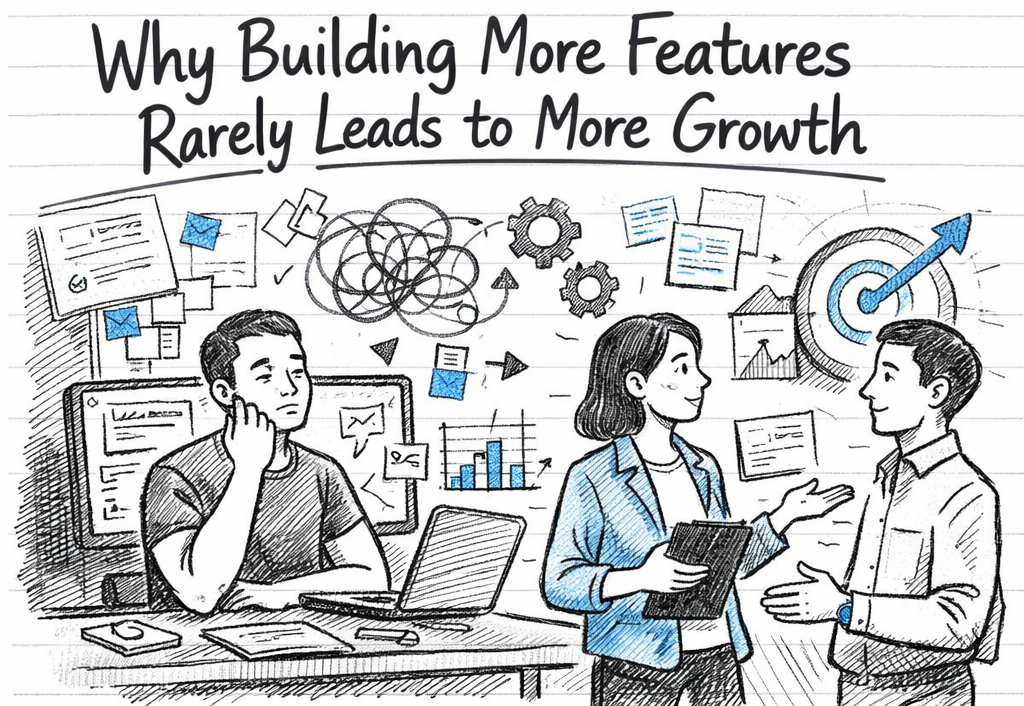
Founders do not need more software for the sake of momentum. They need scalable, production-grade software tied to outcomes that actually move the business.
If you are a founder, shipping more features can feel like progress.
The roadmap is full. The team is busy. New functionality keeps going live.
But growth still feels harder than it should.
That usually points to a deeper problem: your business is investing in software output, but not getting enough business value back.
And that is expensive.
Pendo’s 2024 product benchmarks found that, on average, just 6.4% of features drive 80% of clicks. Best-in-class products do better, but the core message is the same: a small set of features tends to create most of the value. An older but still widely cited Standish Group analysis found something similar: 20% of features were used often, while 50% were hardly ever or never used.
That is the real risk founders face.
Not building too little.
Building too much of the wrong thing.
The cost of building the wrong features is higher than it looks
When a feature misses the mark, the loss is not limited to the original build cost.
You also pay for design time, QA effort, support overhead, added product complexity, onboarding friction, and long-term maintenance. If enough low-value features pile up, they make the product harder to use and the codebase harder to scale.
That user-side cost is real. Research published in Harvard Business Review on “feature fatigue” found that adding capability often reduces usability, and for many customers, more functions translate into lower value in use over time.
The technical cost is just as serious. McKinsey reports that companies often pay an additional 10% to 20% on top of project costs to deal with tech debt, and that some CIOs believe more than 20% of budget meant for new products gets diverted to debt-related issues instead. McKinsey also found that reducing tech debt can free engineers to spend as much as 50% more of their time on value-generating work.
So when founders approve features without a clear link to business outcomes, they are not just funding code. They are often funding future drag.
Why this keeps happening
The disconnect is simple.
Engineering is often measured by delivery.
Founders need outcomes.
So features get approved because they were requested, because a competitor launched something similar, or because they feel urgent in the moment.
But requested does not mean valuable.
And shipped does not mean growth-driving.
This is exactly where many technology investments fall short. PwC reported in 2024 that 88% of executives struggle to capture value from their technology investments, and 85% say it is difficult to update operating models to support a new vision. PwC also points to familiar failure points: poor alignment with business objectives, low user adoption, and failure to measure return on investment.
That should sound familiar to any founder who has ever looked at a busy product roadmap and still felt unsure whether the business was actually getting stronger.
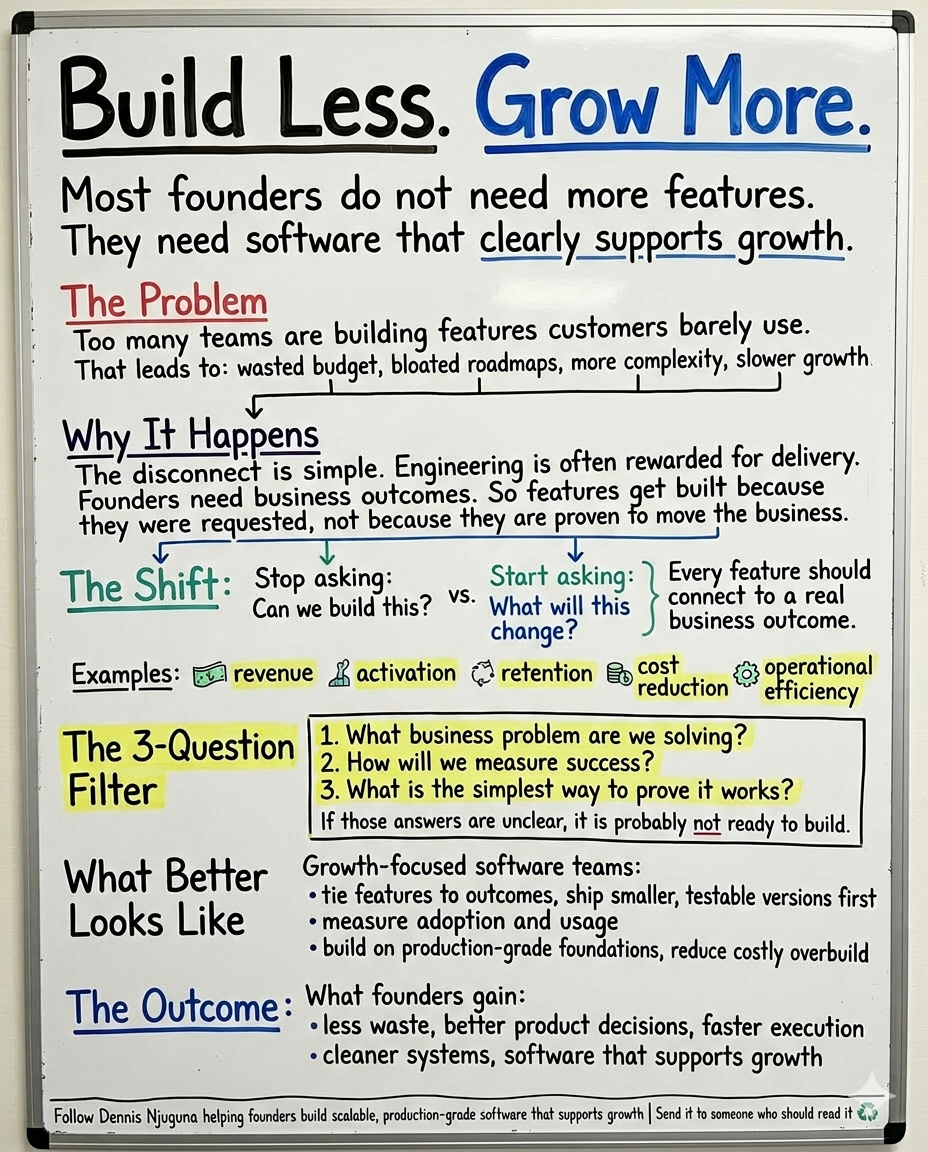
The better question is not “Can we build this?”
It is: What will this change?
Will it improve activation?
Will it lift retention?
Will it increase revenue?
Will it reduce support load or cost-to-serve?
Will it remove friction from a core customer workflow?
If the answer is vague, the feature is probably not ready.
This is not just an opinion. PMI’s 2024 project success research found that projects that define success criteria upfront, put a measurement system in place, and track performance throughout the project have success rates that are nearly twice as high as those that do not. Projects with a measurement system also scored dramatically better than those without one.
That matters because founders do not need more activity. They need clearer evidence that product investment is moving the business in the right direction.
What high-performing teams do differently
High-performing teams do not treat software delivery as a volume game.
They treat it as a system for producing measurable business outcomes.
DORA’s research shows that software delivery metrics can predict organizational performance and team well-being, not just engineering throughput. In other words, measuring delivery quality and stability is not a technical side quest. It is part of how stronger businesses operate.
The best teams also validate faster instead of overbuilding. A Harvard-led study on digital experimentation in startups found that companies adopting A/B testing saw performance improve by 30% to 100% after a year of use. The point is not that every founder needs a massive experimentation platform. The point is that testing ideas earlier and more cheaply creates a real advantage.
That is why strong product execution usually looks like this:
- smaller releases instead of bloated rollouts
- clear success metrics before development starts
- instrumentation built in from the beginning
- ruthless attention to adoption and behavior
- production-grade foundations that can support growth without constant rework
This is how software becomes leverage instead of overhead.
A simple filter founders can use before funding any feature
Before you approve the next build, ask these three questions:
- What business problem are we solving?
- How will we measure success?
- What is the simplest version we can ship to prove value?
If your team cannot answer those quickly and clearly, the problem is probably not engineering speed.
It is prioritization.
And if the feature does go ahead, define the kill rule upfront. Decide what adoption, conversion, retention, or efficiency threshold it needs to hit, and by when. If it misses, improve it or cut it.
That is how disciplined teams avoid turning every product idea into permanent complexity.
Where the right engineering partner creates leverage
This is where founders get the most value from working with the right independent engineer.
Not someone who only executes tickets.
Someone who can connect business priorities to technical execution and build scalable, production-grade software that supports growth.
That means helping you:
- translate product ideas into measurable outcomes
- validate before overbuilding
- add clean instrumentation and dashboards
- ship lean, production-ready increments
- reduce technical debt before it becomes a growth tax
- leave behind systems your team can scale with confidence
The difference is not just cleaner code.
It is better decisions, less waste, faster learning, and software that helps the business grow instead of slowing it down.
The goal is not more software
It is a better software investment.
You do not win by shipping the most features.
You win by building the right things, measuring what matters, and making sure your technical foundation can carry growth when it comes.
If your roadmap is full but growth is not where it should be, that gap is worth examining now, not six months from now when complexity is higher and options are fewer.
Share this article
Send it to someone who would find it useful.