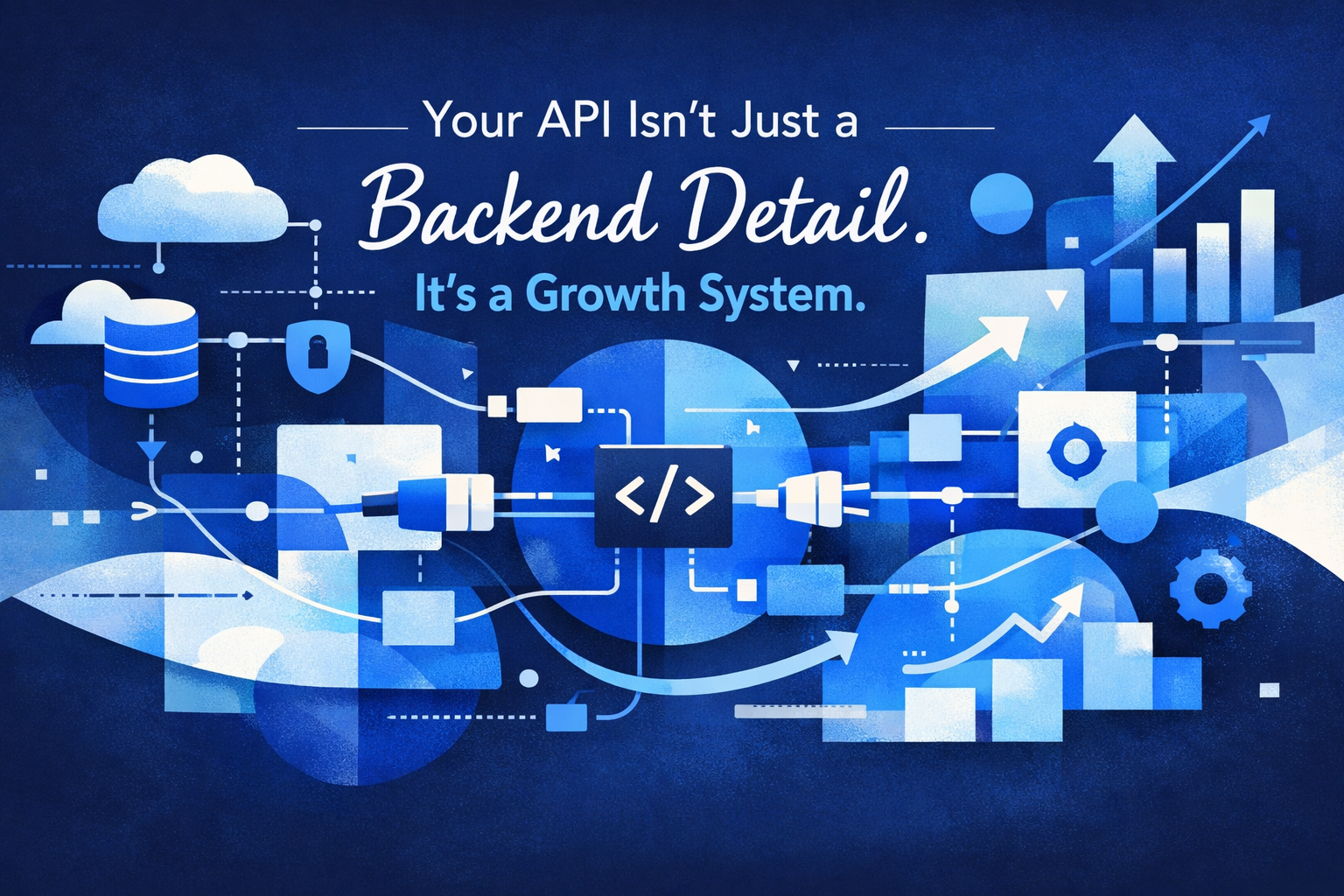
If your product feels harder to ship than it did six months ago, there’s a good chance the problem is not effort.
It’s friction.
And one of the biggest sources of friction inside growing software companies is API design.
Most founders do not notice it right away.
They see the symptoms first.
Releases take longer.
Integrations drag.
Support tickets rise.
Roadmaps slip for reasons that feel annoyingly hard to pin down.
The team is working hard. But the system underneath them is starting to fight back.
That is usually when the API becomes impossible to ignore.
This is not a small technical detail anymore. According to Postman’s 2024 State of the API report, 74% of respondents now describe their organizations as API-first, 62% say they work with APIs that directly generate income, and 40% say API development is guided by business priorities like revenue generation and partnerships. In other words, APIs are no longer just infrastructure. They are operating leverage.
That shift matters because the business cost of bad API design adds up fast. The same Postman research found that 58% of developers rely on internal documentation to learn APIs, 39% say inconsistent docs are the biggest roadblock, 44% dig through source code to understand APIs, and 43% still rely on colleagues to explain how things work. That is not just a developer-experience issue. That is delivery drag.
And that drag shows up in broader engineering research, too. Atlassian’s 2025 State of Developer Experience research found that 50% of developers lose more than 10 hours per week to inefficiencies, 90% lose at least 6 hours weekly, and the top time-wasters include finding information such as services, docs, and APIs.
So let’s call this what it is: If your API is hard to use, your company gets harder to scale.
Why API design is a business problem, not just an engineering problem
A weak API rarely announces itself as “an API problem.”
It shows up as hesitation.
Your engineers slow down because every new endpoint has to be interpreted.
Your partners need more hand-holding than expected.
Your product team starts padding timelines because delivery feels less predictable.
Your support team absorbs the cost when integrations behave inconsistently.
This is exactly why API design best practices matter. They reduce the amount of interpretation your team has to do before it can ship.
That is not a minor productivity gain. It is a compounding advantage.
DORA’s research is useful here because it reinforces a point many teams still miss: speed and stability are not opposites. DORA’s software delivery metrics are designed to measure how safely, quickly, and efficiently teams deliver changes, and its research shows that those metrics predict better organizational performance and employee well-being. High-performing teams do not choose between moving fast and staying stable. They build systems that support both.
Good API design helps create exactly that kind of system.
What bad API design is costing you right now
The cost usually lands in four places.
1. You lose delivery speed
When every endpoint looks like it was designed by a different person on a different day, your team pays a tax every time it touches the API.
That tax shows up as rework, context-switching, documentation hunting, unclear edge cases, and avoidable questions. Postman’s research on API collaboration is blunt: developers are still slowed down by inconsistent docs, source-code digging, and dependency on coworkers to explain APIs. Atlassian’s 2025 data lines up with that pattern, showing that finding information is one of the biggest drains on developer time.
2. You increase release risk
Teams do not just need APIs to be functional. They need them to be predictable under change.
Postman reports that while 56% of API changes succeed with minimal issues, 5% of teams report API change failure rates above 25%. It also found that only 45% of teams use performance testing and only 37% prioritize security testing. That is the kind of gap that stays quiet until production traffic, customer usage, or partner integrations expose it.
3. You create security delays disguised as “extra caution.”
Security debt does not just create breach risk. It slows the business.
Salt Security’s Q1 2025 report found that 55% of organizations had slowed the rollout of a new application into production because of API security concerns, and 58% monitored their primary APIs less than daily. Traceable’s 2025 State of API Security report adds another sharp signal: 57% of organizations reported at least one API-related data breach in the last two years, but only 21% say they have a high ability to detect API-layer attacks.
4. You cap revenue expansion
This one gets ignored the most.
When APIs are hard to use, it takes longer to launch partner integrations, onboard customers, extend product functionality, or open up new revenue channels. Postman’s data shows that APIs are now directly tied to commercial outcomes: 62% of respondents work with income-generating APIs, and 21% say APIs drive more than 75% of company revenue.
That means clunky API design is not just a technical nuisance.
It is a growth constraint.
The API design best practices that matter most
There is a lot of vague advice out there about building “great APIs.”
Most of it is too abstract to help.
So here is the simpler, more useful version: build APIs that reduce cognitive load, make behavior predictable, and hold up under real usage.
That is what production-grade means in practice.
Consistency beats cleverness
This is the first rule because it solves more problems than teams expect.
Use one naming convention. One error format. One pagination strategy. One envelope pattern for success and failure responses. One approach to filtering and sorting. One standard for timestamps, IDs, and field naming.
If every endpoint “feels” the same, your team ships faster because it stops relearning the system.
If every endpoint feels different, velocity becomes luck.
Documentation is part of the product
A lot of teams still treat documentation like a cleanup task.
That is a mistake.
Documentation is how your API becomes usable by people who did not build it. And today’s data makes the case clearly: developers still depend heavily on docs to learn APIs, and inconsistent documentation remains one of the biggest blockers to getting work done.
Good documentation should include:
- real request and response examples,
- clear authentication instructions,
- error examples,
- version notes,
- and a changelog people can actually trust.
If the docs lag reality, the API is effectively unreliable.
Design for failure, not just for demos
Most APIs look acceptable when the happy path works.
That is not the real test.
Production-grade APIs are designed for retries, partial failure, slow upstream services, duplicate requests, timeouts, and degraded dependencies. They return clear errors. They use idempotency where it matters. They fail in ways that help the caller recover safely.
This is also where DORA’s framing is useful: stable systems support faster delivery over time. The goal is not to look elegant in a design review. The goal is to make change easier and safer in production.
Build security into the interface, not around it
Security should not arrive after adoption.
By that point, it usually turns into friction.
Authentication, authorization, scoped access, validation, rate limiting, audit logging, and monitoring should be visible parts of the design. Not scattered afterthoughts.
That matters because API security gaps are no longer hypothetical. Both Salt and Traceable show a landscape where many organizations are still under-monitoring APIs, delaying launches because of security concerns, and struggling to detect attacks at the API layer.
Choose the interface style that fits the product
Not every team needs the same API model.
REST is still a strong default when you want predictable resource-oriented workflows and broad interoperability.
GraphQL is often useful when clients need flexible access to complex data relationships, and over-fetching becomes expensive.
The mistake is not choosing one over the other.
The mistake is adopting either without clear rules, strong schema discipline, and governance.
Flexibility without standards turns into chaos fast.
Treat performance and observability as defaults
Many teams wait too long to think seriously about performance.
That is why load issues show up as surprises.
Caching, pagination, timeouts, rate limits, background processing, and sensible payload sizes should not be “scale-stage concerns.” They are part of responsible API design from the beginning.
So is observability.
If you cannot trace request paths, spot slow endpoints, monitor failure patterns, and understand usage by consumer or key, you are flying blind.
And blind systems become expensive systems.
Version before trust gets broken
Versioning is not exciting.
It is reputation management.
The longer you wait, the harder it becomes to change behavior without hurting customers, partners, or internal teams. Clear deprecation policies, migration guides, and sunset timelines protect trust and reduce fear around change.
That makes future delivery easier.
Which is the point.
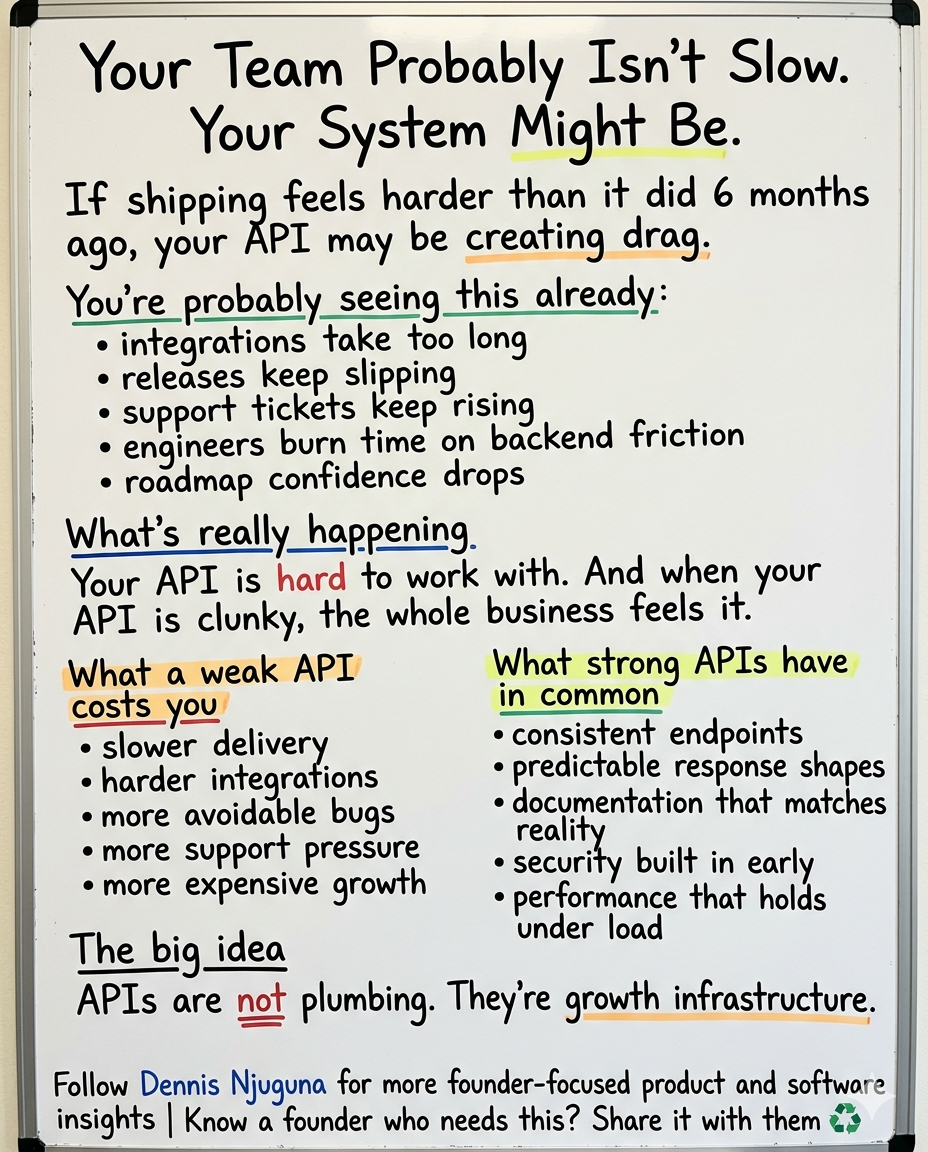
A practical API audit you can run this month
If this article feels familiar, start with five blunt questions:
- Does every endpoint follow the same naming and response logic?
- Can a new engineer or partner integrate without needing tribal knowledge?
- Do your docs match production behavior right now?
- Can your system handle retries, rate spikes, and partial failures safely?
- Can your team explain how auth, permissions, and versioning work without hand-waving?
If the honest answer is “not really” on more than one of those, your API is already creating business drag.
That does not mean the system is broken.
It means the next phase of growth will cost more than it should unless you tighten the foundation now.
What founders should take from this
You are not buying API improvements for aesthetic reasons.
You are buying:
- faster delivery,
- cleaner integrations,
- fewer support issues,
- less engineering rework,
- and a product that gets easier to extend instead of harder.
That is why this work matters.
If your product is growing but your systems are starting to feel heavier, that is exactly the moment to look harder at the API.
Final thought
The strongest APIs do not win because they are the most clever.
They win because people can use them confidently.
Your engineers move faster.
Your partners integrate faster.
Your product extends more cleanly.
Your business carries less friction.
That is what good API design buys you.
And that is why API design best practices are not just engineering hygiene.
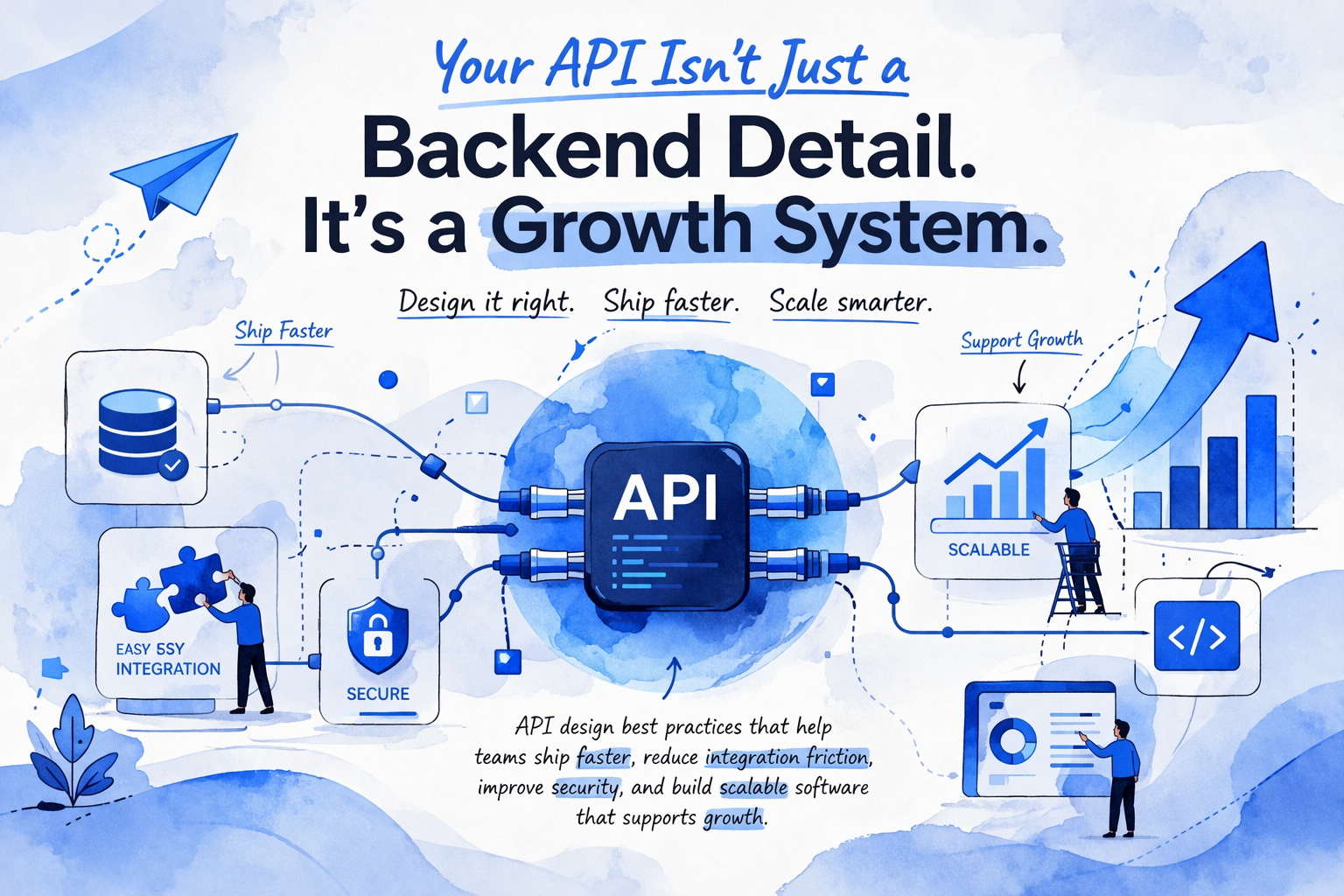
They are growth infrastructure.
Share this article
Send it to someone who would find it useful.