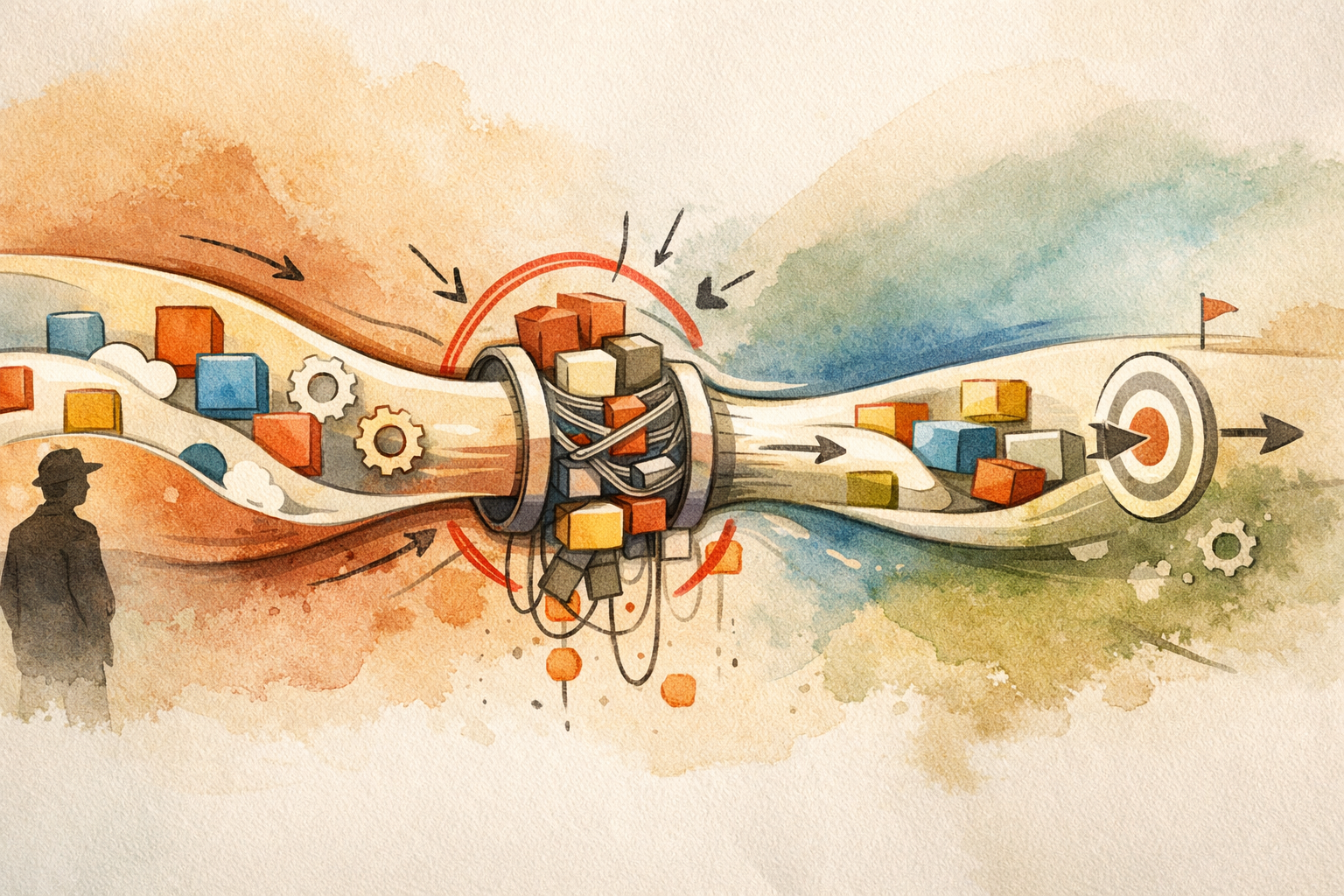
You probably don’t describe your problem as a “software delivery bottleneck.”
You describe it differently.
A sprint slips.
A feature stalls in QA.
The frontend is done, but the backend isn’t.
The API works, but the user flow still feels broken.
A release gets pushed because staging doesn’t match production.
Again.
Nothing about it feels dramatic in the moment.
That’s why it gets ignored for so long.
But if you’re a founder, product lead, or engineering leader, you already know the business impact is real. Delays compound. Roadmaps become negotiations. Teams stay busy, but shipping still feels slower than it should.
And that’s the part worth paying attention to: most teams that feel “slow” do not have a talent problem first.
They have a delivery system problem.
Why this matters more now than it did a year ago
A lot of teams assumed AI tools would erase delivery friction.
They didn’t.
Atlassian’s 2025 State of Developer Experience survey, based on 3,500 developers and managers, found that 99% of developers report saving time with AI tools, and 68% say they save more than 10 hours a week. But the same research found 50% still lose 10+ hours a week and 90% lose at least 6 hours weekly, largely because of organizational inefficiencies. The biggest drains were finding information, adapting to new technology, context switching between tools, and collaboration with other teams. Atlassian also found that developers spend only 16% of their time coding, which is a good reminder that code is rarely the only bottleneck.
DORA’s 2025 research makes the same point from another angle: AI mostly amplifies the strengths and weaknesses already present in your system, and the biggest returns come from improving the underlying organization, not just adding more tools.
That means the question is no longer, “Do we have better tools?”
It’s, “Does our delivery system actually allow good people to move fast?”
What software delivery bottlenecks actually look like
If this sounds familiar, you’re probably dealing with one already:
- The frontend team is waiting on APIs.
- The backend team ships endpoints without enough context on user behavior.
- Requirements are technically “clear,” but everyone interprets them differently.
- Bugs only show up when the whole flow is stitched together.
- Release confidence is low, so everything moves through more meetings, more approvals, and more caution.
This is why bottlenecks are often misunderstood.
They rarely live inside one individual.
They usually live at the boundary between functions.
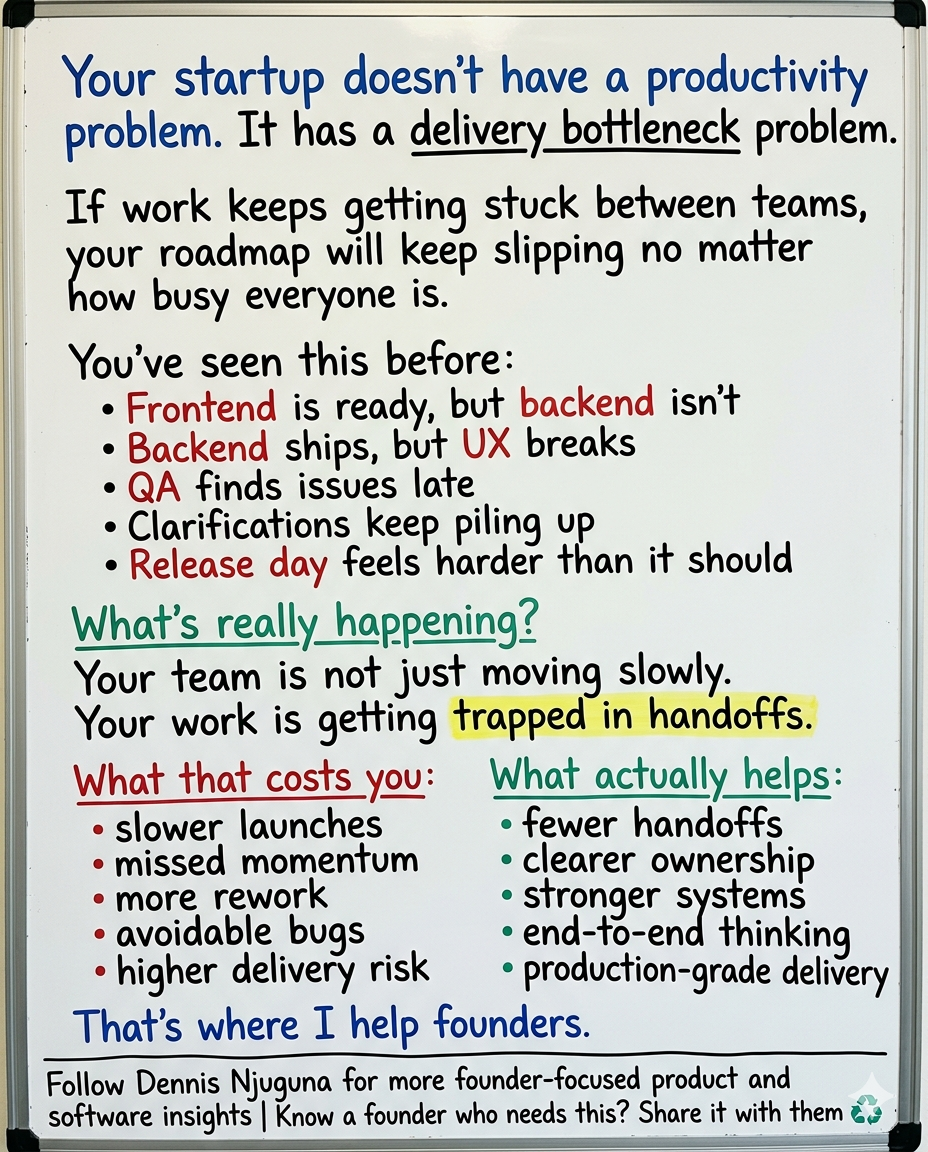
That boundary might be the frontend and backend. It might be engineering and product. It might be development and operations. But the pattern is the same: every extra handoff introduces waiting, interpretation risk, and rework.
DORA explicitly warns against siloed ownership, noting that isolating teams around narrow metrics creates friction and finger-pointing. The same guidance recommends gathering the cross-functional team responsible for prioritizing, building, delivering, and operating an application to improve delivery performance together.
That is the real shift.
Not “everybody must do everything.”
But the people closest to delivery need enough end-to-end understanding and ownership that the work doesn’t keep getting trapped between teams.
The hidden business cost of software delivery bottlenecks
This is where founders often underestimate the damage.
A delivery bottleneck is not just an engineering annoyance.
It shows up as:
- slower revenue experiments
- more time spent coordinating than building
- higher bug-fix costs
- less confidence in launches
- more production risk
McKinsey has argued that generative AI can help developers complete some tasks up to two times faster. But it also found that when companies measured and improved developer productivity more deliberately, they saw 20 to 30% fewer customer-reported defects, a 20% improvement in employee experience, and a 60-percentage-point increase in customer satisfaction ratings in early implementations. That’s the difference between “writing code faster” and “shipping better outcomes.”
And when delivery issues spill into production, the stakes rise fast. IBM’s 2024 Cost of a Data Breach Report found the global average cost of a data breach reached $4.88 million, while 70% of breached organizations reported significant or very significant business disruption. That report is about breaches specifically, but the broader lesson is simple: once quality, security, and recovery are handled late, the costs stop being theoretical.
So yes, bottlenecks slow teams down.
But they also make growth more expensive.
The best teams are not just faster. They are designed to move better.
This is where a lot of advice goes wrong.
People say, “Just hire better engineers.”
That’s incomplete.
Good engineers in a weak system still produce drag.
The stronger move is to design for flow.
DORA’s software delivery framework is useful here because it keeps the conversation grounded in what actually matters. DORA says its five software delivery metrics predict better organizational performance and team well-being, and it also makes a point many founders need to hear: speed and stability are not tradeoffs. Top performers do well across both.
In other words, the goal is not to choose between moving fast and staying reliable.
The goal is to build a system where those reinforce each other.
CircleCI’s 2025 State of Software Delivery report, based on nearly 15 million workflows from more than 22,000 organizations in 149 countries, found that top-performing teams were shipping updates 3x faster than bottom-quartile teams and completing critical workflows 5x faster. That gap is too large to explain away with “better effort.” It points to better systems, better feedback loops, and less friction inside delivery.
How to spot software delivery bottlenecks before they get expensive
If you want a practical founder-level diagnostic, start here.
1. Look for where work waits, not just where work happens
Most teams track activity.
Fewer track waiting.
But waiting is where the real cost hides.
Ask:
- Where do tickets pause most often?
- Where do clarifications repeatedly show up?
- Where do engineers need to “hand off and hope”?
- Where do releases become tense?
The answer is usually more revealing than velocity charts.
2. Measure the flow of delivery, not just output
DORA’s five software delivery metrics give you a clean starting point: change lead time, deployment frequency, failed deployment recovery time, change fail rate, and deployment rework rate. You do not need perfect instrumentation on day one, but you do need some view into how long changes take, how often they break, and how much unplanned work gets created after release.
If a feature “ships” quickly but creates a rollback, hotfix, or a week of cleanup, that’s not speed.
That’s deferred cost.
3. Watch for handoff-heavy architecture and process
If every meaningful change requires three people, two meetings, and a lot of translation, the system is telling you something.
You may have:
- unclear API contracts
- too much tool switching
- weak environment parity
- late-stage testing
- narrow ownership boundaries
The fix is rarely more coordination alone.
Usually, it is clearer interfaces, smaller batch sizes, and fewer dependencies. DORA specifically recommends reducing the batch size of changes and improving the most significant constraint or bottleneck first.
What to fix first if you want the delivery to speed up
This is the part founders tend to overcomplicate.
You do not need a grand transformation before you can improve flow.
Start with these three moves.
i) Reduce avoidable handoffs
Not every engineer needs to be identical.
But someone needs to be able to carry a feature from requirement to production with fewer breaks in ownership.
That means hiring and structuring around outcomes, not just titles.
ii) Standardize the interface between teams
Clear API contracts. Shared staging standards. CI checks. Early validation. Better documentation.
This matters more than another “alignment meeting.”
Remember: Atlassian’s research found that developers’ top time-wasters included finding information, context switching, and collaboration friction with other teams.
That is not a talent issue.
That is a systems design issue.
iii) Build a production-grade delivery habit early
CI/CD, monitoring, rollback readiness, environment parity, and security basics are not “later” concerns.
They are how growing teams avoid turning every release into a gamble.
The goal is not just to ship code.
It is to ship with confidence.
Where founders usually get the most leverage
This is exactly where outside support can create disproportionate value.
Not because you need someone to “help with a few tickets.”
Because you may need someone who can connect the dots across architecture, delivery, and production readiness.
That means:
- tightening requirements
- designing scalable architecture
- reducing frontend/backend friction
- building production-grade features end-to-end
- setting up delivery systems that support growth instead of fighting it
That’s the work that changes how a team ships.
And that’s the difference between software that merely works and software that actually supports the next stage of the business.
Final thought
If your team feels busy but your roadmap still slips, don’t assume the problem is effort.
Look at the system.
Look at the handoffs.
Look at the places where work keeps waiting for permission, translation, or rescue.
That’s usually where the bottleneck is.
And once you fix that, everything downstream starts moving differently.
Share this article
Send it to someone who would find it useful.