
Most founders assume software starts breaking down because of bad code.
That’s usually not the first failure.
The first failure is losing control of the software lifecycle.
You feel it before you can name it. Releases become heavier. Bugs show up later. Security questions surface too close to launch. Product, engineering, and leadership all think they’re aligned, but every important release still feels more stressful than it should.
And this matters more now because the volume and speed of software change are rising. Google’s 2025 DORA research found AI adoption among software development professionals had reached 90%, with over 80% saying AI improved productivity and 59% reporting a positive effect on code quality. But the same research makes a harder point: AI acts more like a multiplier than a cure. Strong systems get stronger. Weak systems get exposed faster.
That’s why founders who are growing quickly often misdiagnose the problem. They ask for more speed when what they actually need is better software lifecycle management.
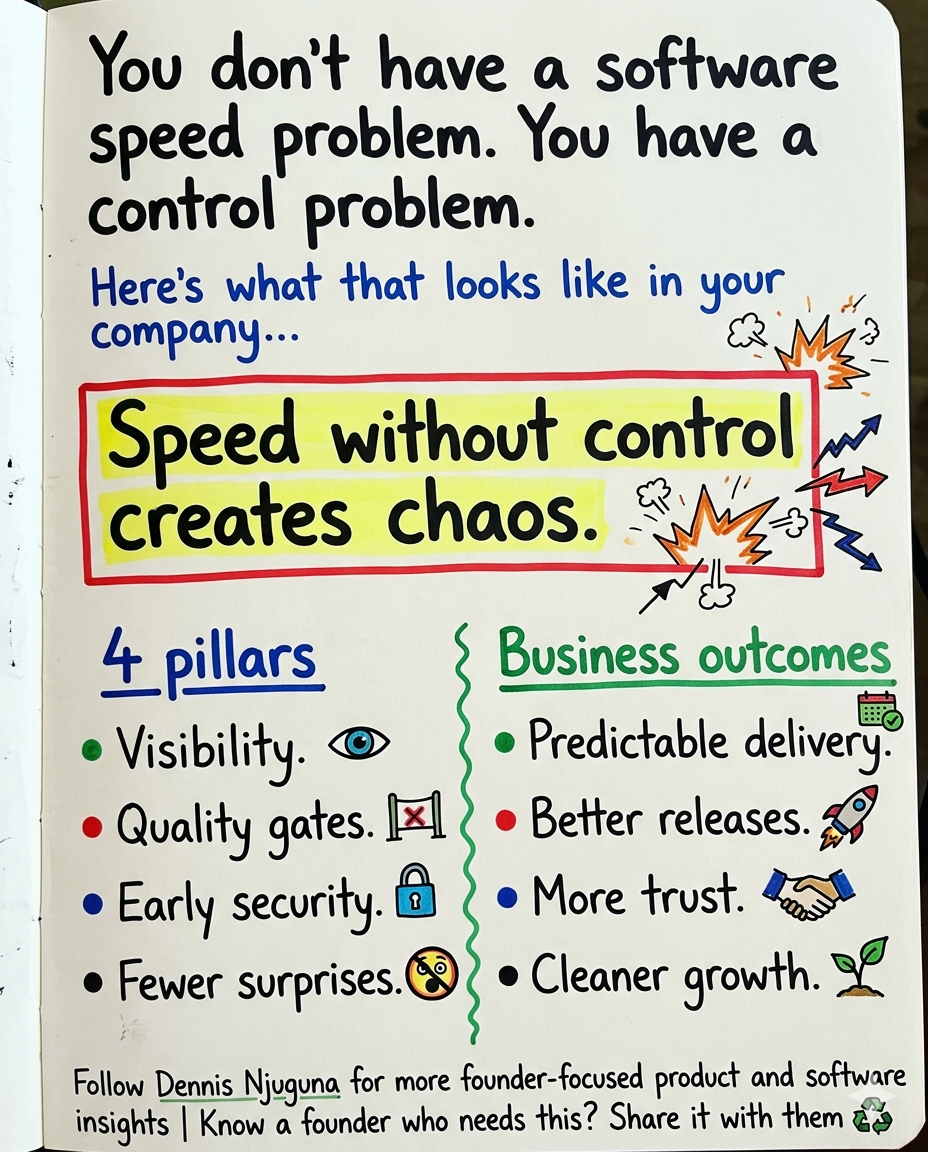
Because speed without lifecycle control does not create momentum.
It creates expensive motion.
And the costs are not theoretical. GitLab’s 2025 Global DevSecOps research, based on a survey of 3,266 practitioners, found that teams lose about 7 hours per person every week to inefficient processes. It also found 60% of respondents use more than five software development tools, 49% use more than five AI tools, and 76% say more compliance issues are discovered after deployment than during development.
That’s the backdrop for this article.
Not “how to code better.”
Not “how to run more sprints.”
But how to build a software lifecycle that actually supports growth.
What software lifecycle management actually means
Software lifecycle management is the system you use to control how software moves from idea to production to monitoring to improvement.
That includes planning, architecture, implementation, testing, security, deployment, observability, rollback, incident response, and decision-making. In other words, it is not just a project management layer. It is the operating system behind delivery.
This is where a lot of companies get confused.
They think Jira is lifecycle management.
It isn’t.
They think standups are lifecycle management.
They aren’t.
They think hiring more developers will fix delivery gaps.
Usually, it won’t.
Real software lifecycle management answers a different set of questions:
- Who owns what?
- What quality gates must every release pass?
- Where does risk become visible?
- How do you know something is production-ready?
- What happens if a release degrades performance or trust?
- How quickly can you detect, contain, and reverse problems?
If those questions are fuzzy, growth will eventually make them painful.
Why founders usually feel this problem late
Early on, a startup can get away with a lot.
A few strong engineers can carry too much context. Founders can jump in and unblock decisions informally. Teams can fix issues manually. Releases can go out without much ceremony because the blast radius is still small.
Then the company grows.
More customers.
More integrations.
More compliance pressure.
More expectations around uptime, privacy, and trust.
More AI features and automation are layered into the product.
That’s when informal systems stop being charming and start becoming risky.
IBM’s 2025 Cost of a Data Breach report puts the average global cost of a breach at $4.4 million. The same report says 63% of organizations lacked AI governance policies, and organizations with extensive use of AI in security saved $1.9 million compared with those that did not.
At the same time, Veracode’s 2025 State of Software Security report found that the average time to fix security flaws has increased 47% since 2020. It also reports that half of organizations have critical security debt, and 70% of that debt comes from third-party code and the software supply chain.
That combination should get any founder’s attention.
You are shipping faster.
Your attack surface is growing.
Your dependencies are riskier.
And the cost of finding problems late is still brutally high.
That is exactly why software lifecycle management becomes a business issue long before it looks like a pure engineering issue.
What good software lifecycle management looks like in practice
The good news is that this is fixable.
Not with more process theater.
Not with another dashboard nobody checks.
And not by slowing everyone down.
Good software lifecycle management gives your team more control with less drama. Here’s what that looks like.
1. Visibility you can actually act on
You should not need a launch failure to understand where delivery risk is building.
A healthy lifecycle gives you simple, decision-ready visibility into:
- what’s shipping this week?
- what’s blocked?
- what’s high risk?
- who owns the outcome?
- and what still needs review before release.
This does not require twenty reports.
It requires a small number of signals people actually use: milestone health, defect trends, production incidents, unresolved security findings, lead time, and ownership.
The point is clarity, not surveillance.
Founders do not need more data. They need better operational truth.
2. Quality gates that are built into the workflow
A lot of teams still rely on memory and heroics.
“Did we run the full test suite?”
“Did anyone check performance?”
“Do we have a rollback plan?”
“Did we scan dependencies?”
If the answer depends on whether someone remembered, the system is fragile.
Quality gates should be part of the workflow itself. CI/CD should automatically run tests, checks, and security scans. Your definition of done should include performance expectations, monitoring readiness, and rollback planning. Release readiness should be a standard, not a debate.
This is where the DORA and GitLab findings become practical. If AI is helping teams generate more code, but fragmented workflows and weak controls still sit downstream, you do not get scalable speed. You get more throughput entering a bottleneck.
3. Security and ethics handled early, not late
Founders usually do not intend to treat security, privacy, or governance as an afterthought.
It happens because everyone is trying to move fast.
But late-stage governance is one of the most expensive habits a company can build.
If your product handles customer data, sensitive workflows, AI-assisted decisions, or regulated behavior, you need lifecycle controls that address that reality early. That means access rules are documented, encryption is deliberate, privacy is reviewed during design, and audit trails exist for high-impact changes.
IBM’s 2025 breach data is especially useful here because it shows the gap is not just technical. It is governance-related. Nearly all organizations in the report that had AI-related security incidents also lacked proper AI access controls, and many still had no policy framework in place.
That is not a future problem.
That is a current operating problem.
4. Release confidence, not release anxiety
Founders know this feeling: the team says a release is ready, but nobody sounds calm.
That usually means the lifecycle is not doing its job.
A solid lifecycle creates confidence before launch, not just recovery after launch. It makes sure every release has clear ownership, validated dependencies, rollout planning, monitoring, rollback criteria, and post-release accountability.
The question is not “Can we deploy?”
The question is “Can we deploy without gambling on luck?”
Those are very different standards.
5. Feedback loops that make the system smarter
A scalable software team does not just ship.
It learns.
That means incidents feed back into architecture decisions. Repeated defects influence the definition of done. Support trends inform product priorities. Security findings affect dependency policy. Slow reviews trigger workflow changes.
Without these loops, teams repeat the same mistakes at a higher volume.
With them, delivery gets calmer, faster, and more predictable over time.
That is what mature software lifecycle management really does: it compounds learning.
The founder's mistakes that quietly make this worse
There are a few patterns I see over and over.
- The first is optimizing for sprint output instead of end-to-end delivery quality.
- The second is buying more tools instead of fixing handoffs, ownership, and workflow design.
- The third is treating security and compliance like a final checkpoint rather than a design constraint.
- The fourth is assuming outsourced delivery includes strategic accountability. Often, it includes shipping. It does not always include long-term lifecycle ownership.
- The fifth is waiting too long to simplify architecture, tighten release workflows, and standardize production readiness.
None of these mistakes feels dangerous in the moment.
That is why they survive.
But over time, they become the hidden tax on growth.
What founders should put in place next
If your company is growing and software is becoming more business-critical, start here:
Set one shared definition of done that includes testing, security, monitoring, and rollback readiness.
Create a weekly control review across product, engineering, and leadership: what shipped, what is risky, what is blocked, and what decisions are needed.
Reduce unnecessary tool sprawl where it creates handoff friction and fragmented accountability.
Track a small set of lifecycle metrics that matter: delivery flow, defect escape rate, incidents, unresolved security debt, and ownership of open risks.
Treat production readiness as a system, not a heroic last-mile effort.
That will not make your team slower.
It will remove the friction that is already slowing them down.
Where senior technical leadership changes the game
At a certain point, founders do not need more hands.
They need a better structure.
That usually means bringing in someone who can see the whole system: architecture, delivery pipeline, release quality, security posture, and business risk. Someone who can reduce bottlenecks without gold-plating the stack. Someone who can help the team ship production-grade software with more confidence and fewer late-stage surprises.
That is the difference between building features and building a software capability that can support growth.
It is also a big part of the work I do.
I help founders build scalable, production-grade software that supports growth.
In practice, that often means tightening CI/CD, improving release quality, simplifying architecture, reducing cross-functional bottlenecks, and putting stronger lifecycle controls in place before growth turns hidden weaknesses into visible failures.
Final thought
Most founders do not lose momentum because their team cannot code.
They lose momentum because the company outgrows the way software gets planned, built, tested, shipped, and governed.
That is a lifecycle problem.
And lifecycle problems do not stay technical for long.
They become revenue problems. Trust problems. Reputation problems. Leadership problems.
If your team is shipping more code but feeling less confident, there is a good chance the issue is not velocity.
It is software lifecycle management.
Share this article
Send it to someone who would find it useful.