If your product feels slower than it should, your first instinct is probably to blame traffic.
More users.
More requests.
More load.
More infrastructure.
That’s the obvious story.
It’s also often the wrong one.
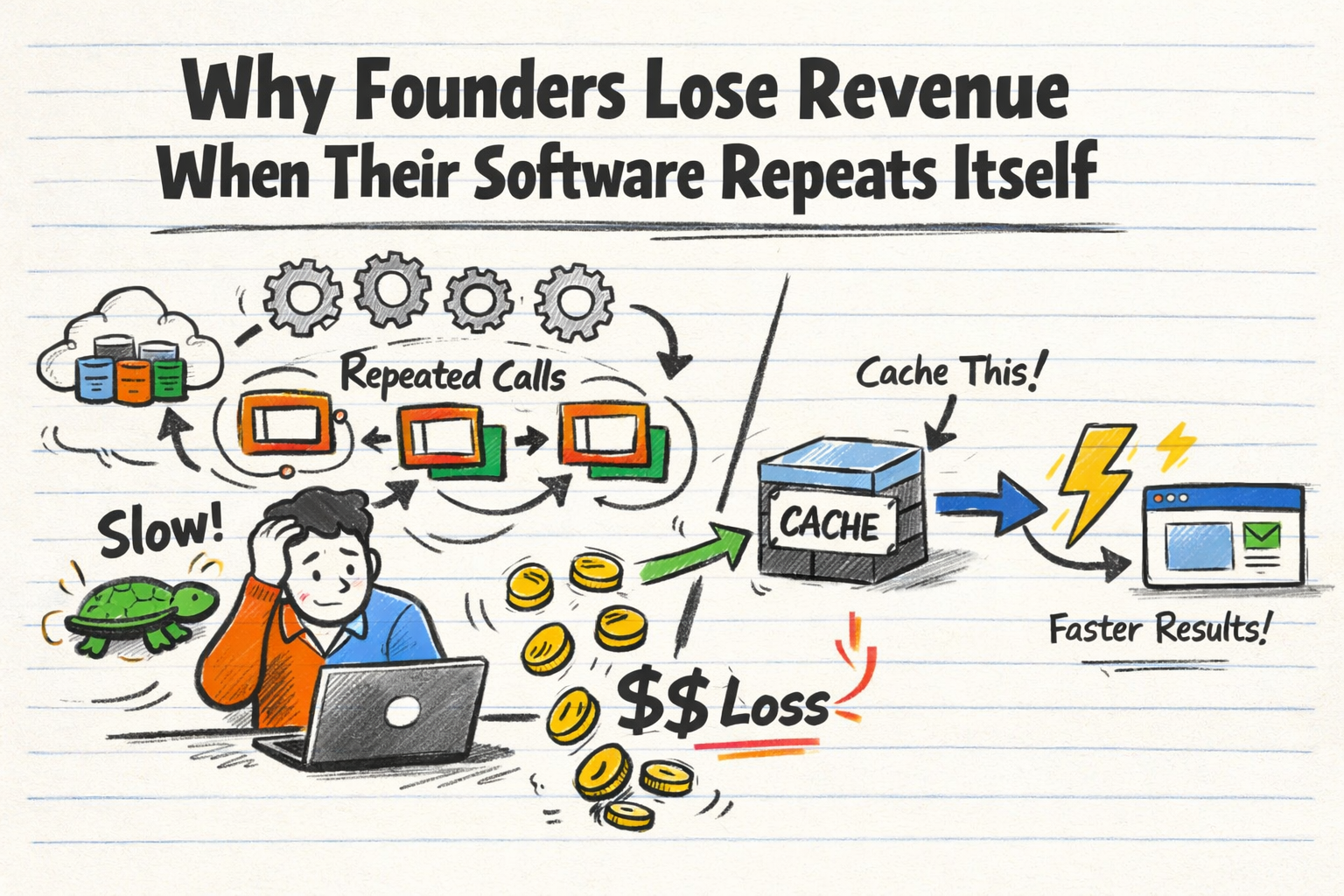
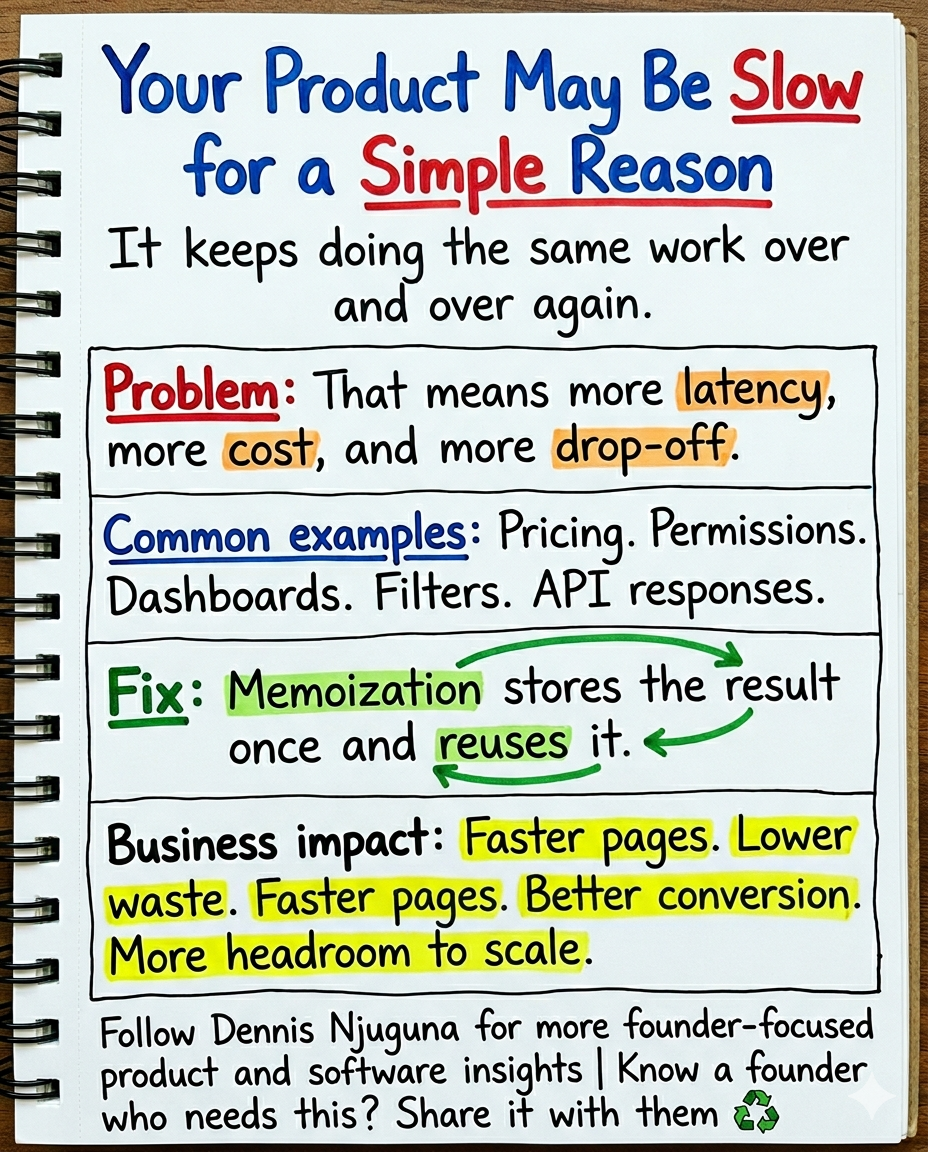
A lot of software slows down for a much simpler reason: it keeps doing the same work over and over again.
The same pricing logic.
The same permission checks.
The same filters.
The same aggregates.
The same responses, recalculated as if nobody has asked the question before.
Founders usually don’t notice this at first because nothing looks broken.
The app still loads.
The API still responds.
The dashboard still eventually renders.
But users feel the drag long before your team treats it like a serious business issue.
And that matters, because speed is no longer a “nice to have” layer on top of product quality. Google’s current guidance still centers page experience around Core Web Vitals, with a good Largest Contentful Paint at 2.5 seconds or less, good Interaction to Next Paint at 200 milliseconds or less, and Google explicitly says Core Web Vitals are used by its ranking systems.
That pressure shows up in user behavior, too. Google says 53% of mobile visits are likely to be abandoned if a page takes longer than 3 seconds to load. web.dev also recommends most sites aim for a Time to First Byte of 0.8 seconds or less as a practical server-response target.
So no, slow software is not just a technical annoyance.
It is a conversion problem.
A trust problem.
A margin problem.
And if you’re trying to grow, it becomes a scale problem fast.
The web is getting better, but the bar is still high
One mistake I see founders make is assuming everyone else’s software is just as clunky, so a little slowness is normal.
It isn’t.
The latest HTTP Archive Web Almanac, published in January 2026 using 2025 data, found that only 48% of mobile websites and 56% of desktop websites achieved good Core Web Vitals overall. Home pages performed even worse: just 45% of mobile home pages and 47% of desktop home pages passed.
That should get your attention for two reasons.
- First, performance is still a competitive gap. If your site is fast, you are still ahead of a large chunk of the web.
- Second, “better than average” is not the same as “good enough to support growth.” Google’s thresholds are based on real user experience, not developer optimism.
This is where founders get into trouble. They assume performance work is something you do later, after traction.
But traction is exactly what exposes weak systems.
The moment usage rises, repeated work gets expensive. Your app spends more CPU time repeating solved calculations, your users wait longer, and your cloud bill quietly climbs for work that never needed to happen in the first place.
What repeated work actually costs you
Slow software rarely announces itself with drama.
It leaks value quietly.
A page that loads a little slower converts a little worse.
An endpoint that recomputes the same response burns a little more compute.
A dashboard that rebuilds the same aggregates on every request adds a little more latency.
A product that feels slightly sluggish loses a little more trust.
Those “little” losses compound.
Portent’s 2022 analysis of more than 27,000 landing pages found that for B2B sites, a page that loads in 1 second converted about 3x better than one that loads in 5 seconds. For e-commerce, a 1-second page load converted about 2.5x better than a 5-second load.
Deloitte’s “Milliseconds Make Millions” research found that even a 0.1-second improvement in mobile site speed correlated with meaningful business gains: retail conversions rose 8.4%, travel conversions rose 10.1%, retail average order value increased 9.2%, and lead-generation bounce rate improved 8.3%. Deloitte analyzed mobile site data across retail, travel, luxury, and lead-gen brands in Europe and the US, and web.dev summarizes the same findings as a broad purchase-funnel lift from tiny speed improvements.
That’s the real point: you do not need a massive outage to lose money.
You just need enough repeated inefficiency to make the product feel heavier than it should.
One of the cleanest fixes: memoization
This is where memoization becomes useful.
Strip away the jargon and the idea is simple: when the same input produces the same output, stop recalculating it every time. Save the result. Reuse it the next time the same request comes in.
That’s memoization.
Not magic.
Not theory.
Not “premature optimization.”
Just a disciplined way to remove repeat work from systems that should already know the answer.
In practice, this tends to be valuable when a task is:
- expensive
- repeated
- deterministic
That combination matters.
If a result changes every second, memoization may be the wrong tool.
If a result is personalized, sensitive, or hard to invalidate safely, you need stronger guardrails.
But when the same request pattern keeps showing up with the same answer, refusing to cache or memoize it is often just paying extra for no business value.
Where memoization usually delivers outsized wins
I see the biggest gains in places founders often underestimate because the logic seems “small.”
Pricing and discount calculations are a common one. A few rules here, a few conditions there, and suddenly every cart interaction is forcing the system through work it has already done.
Permissions and feature-flag checks are another. Teams love stacking these checks everywhere, then act surprised when “simple” pages feel heavier under load.
Dashboard aggregates are classic offenders too. If your reporting layer rebuilds expensive totals every time someone refreshes a page, you are trading speed and compute for no real upside.
Product filtering, shipping or tax logic, search facets, and high-traffic API responses are also strong candidates when the inputs are repeated frequently enough.
This is where website speed optimization stops being generic advice and becomes engineering leverage.
Because now you are not just compressing images or deferring JavaScript.
You are removing wasted backend work.
And that often does more for real-world performance than another round of cosmetic front-end cleanup.
The part that separates real engineering from hacks
Memoization is powerful.
It is also easy to do badly.
This is where weaker teams create performance bugs while trying to fix performance.
If you cache too aggressively, users see stale data.
If you cache sensitive per-user output carelessly, you create security and correctness problems.
If you never define invalidation, your “speed fix” turns into a trust problem.
So the right approach is professional, not casual:
- define what can be safely memoized
- set TTLs or eviction rules
- design invalidation before rollout, not after bugs appear
- separate shared results from user-specific results
- measure before and after
That last one matters more than people admit.
You should know whether the change improved response time, reduced compute, increased cache hit rate, or improved user-facing metrics like LCP and conversion. Google’s guidance is explicit that Core Web Vitals are based on real-world user experience, and Search Console’s Core Web Vitals report is built around field data.
In other words: don’t optimize for vibes.
Optimize for measured outcomes.
What founders should take from this
If your software supports growth, it should not get disproportionately slower and more expensive every time demand increases.
That is not scale.
That is accumulated inefficiency.
And one of the fastest ways to create that inefficiency is to let the system repeat work that should have been reused.
I help founders build scalable, production-grade software that supports growth. This is exactly the kind of issue I look for early, because it sits at the intersection of engineering quality and business performance.
Done right, memoization can help you:
- reduce latency on hot paths
- lower unnecessary compute spend
- improve page and API responsiveness
- create more headroom for traffic spikes
- make the product feel more trustworthy under load
None of that is abstract.
It affects conversion.
It affects retention.
It affects operating margin.
And it affects how confident you feel when the business starts growing faster.
A better question to ask your team
Most founders ask, “Do we need more infrastructure?”
A better question is: Where are we recomputing the same answer more than once?
That question tends to uncover the real issue faster.
If your app has an endpoint, page, or workflow that keeps recalculating the same thing again and again, there is a good chance you are sitting on a performance win you have not captured yet.
If that sounds familiar, book a discovery call.
And if you want more practical breakdowns on building software that stays fast, reliable, and scalable as the business grows, subscribe to the newsletter.
Because growth is hard enough.
Your software should not be making it harder.
Share this article
Send it to someone who would find it useful.