
Most contact management software looks simple at first.
A table. A few forms. Search. Edit. Delete. Nothing dramatic.
Then your team starts depending on it every day.
Support updates records while a customer is waiting. Finance needs the right billing contact. Operations need clean data. Compliance needs traceability. Suddenly, a “simple” contact system is no longer simple at all. It becomes part of the infrastructure that keeps the business moving.
And when that system is clunky, the cost shows up everywhere.
Validity’s 2024 CRM data management report found that 24% of CRM admins said less than half of their data is accurate and complete, while 31% said poor-quality data costs them at least 20% of annual revenue. IBM’s 2026 analysis says over a quarter of organizations estimate they lose more than USD 5 million annually due to poor data quality, with 7% reporting losses of USD 25 million or more. Poor data quality does not stay hidden for long; it usually shows up downstream as lost revenue, inefficiency, compliance risk, and missed opportunities.
That is why contact management is not a small feature.
It is business infrastructure.
Why contact management becomes expensive fast
The problem is not that contact data exists. The problem is what happens when the system around it is weak.
A bad workflow does not just annoy users. It creates second-guessing, duplicate records, accidental deletes, and time wasted fixing problems that should never have happened in the first place. Once a team stops trusting the system, they start working around it. That is when friction turns into real cost.
This is also why UX is not just a polish layer. McKinsey found that companies in the top quartile of design performance grew revenue 32 percentage points faster and delivered 56 percentage points higher shareholder returns over five years. NN/g’s usability research has also shown that redesigns can improve desired metrics by 135% on average. In other words, better design and usability are not cosmetic. They change outcomes.
For contact management, that matters even more. Users are not browsing for fun. They are trying to find one record, change one thing, and move on.
If the tool gets in the way, the business pays.
What this project is designed to do
This project is a production-minded contact management module built in React.
It handles the essentials well: add, edit, delete, search, sort, confirmations that prevent mistakes, instant feedback through toasts, sequential IDs for readability, and a clean interface that works across screen sizes.
This is not CRUD for the sake of a demo.
It is CRUD with the rough edges removed so it feels safe, fast, and trustworthy.
That distinction matters.
Because in real products, contact management often sits inside CRMs, admin dashboards, billing tools, support systems, and internal workflows. If the interface feels slow or uncertain, the whole operation feels slower too.
What goes wrong in most contact systems
Most contact systems fail in the same predictable ways.
- The first issue is accidental mistakes. A user clicks the wrong row. A delete happens too quickly. An edit happens without enough context.
- The second issue is uncertainty. The user changes something and then wonders whether it saved.
- The third issue is data quality decay. Duplicate records, invalid emails, and incomplete fields pile up until the database becomes harder to trust than to use.
Once that happens, the team stops moving confidently.
And once confidence drops, productivity drops with it.
That is why a good contact management system needs more than a table and a form. It needs intentional UX, strong feedback, and a state model that stays predictable as the product grows.
Who this is for
This approach is especially useful for teams building:
- SaaS account administration, including billing contacts and notification recipients
- CRM or support tools where updates happen during live customer interactions
- internal tools for operations, finance, or compliance
- admin dashboards that need to feel reliable instead of clunky
If your product depends on clean contact data, this is the kind of software architecture worth getting right early.
Why the UX details matter
In internal tools, small design decisions compound fast.
A confirmation modal prevents a costly mistake. A clear success toast removes doubt. A fast search box saves minutes across repeated workflows. A readable ID makes audits and support conversations easier. A responsive layout keeps the system usable on any screen. Clean state updates make the code easier to extend later.
None of that looks flashy.
All of it matters.
NN/g’s research has long made the case that usability work pays back quickly, and McKinsey’s design research shows that stronger design capability correlates with stronger business performance. That is the pattern here too: better usability leads to fewer errors, faster work, and more trust in the system.
For founders, that translates into something very practical: lower operational friction and software that does not slow the team down.
What good contact management should actually feel like
A good contact system should feel calm.
The user should be able to find the right person quickly, update the record with confidence, and move on without asking, “Did that save?”
It should do a few things really well:
It should make edits obvious.
It should make destructive actions deliberate.
It should give immediate feedback.
It should keep search and sorting fast.
It should stay understandable as the list grows.
That is what a production-grade contact system looks like in practice.
Not fancy. Just dependable.
And for business software, dependable is a competitive advantage.
How this helps the business
This is where the value becomes obvious.
For support teams, a clean workflow means faster updates during live calls and fewer mistakes under pressure. For billing and operations, it means less time chasing bad data and fewer avoidable follow-ups. For compliance, it means clearer traceability and less chaos when records need to be reviewed. For founders, it means a system that supports growth instead of creating hidden drag.
IBM’s research is a good reminder that poor data quality rarely hurts right at the point of failure. It usually surfaces later, after the problem has already spread. That is what makes it expensive.
So the real question is not whether contact management matters.
It is whether your current system is making the business faster or quietly making it harder to run.
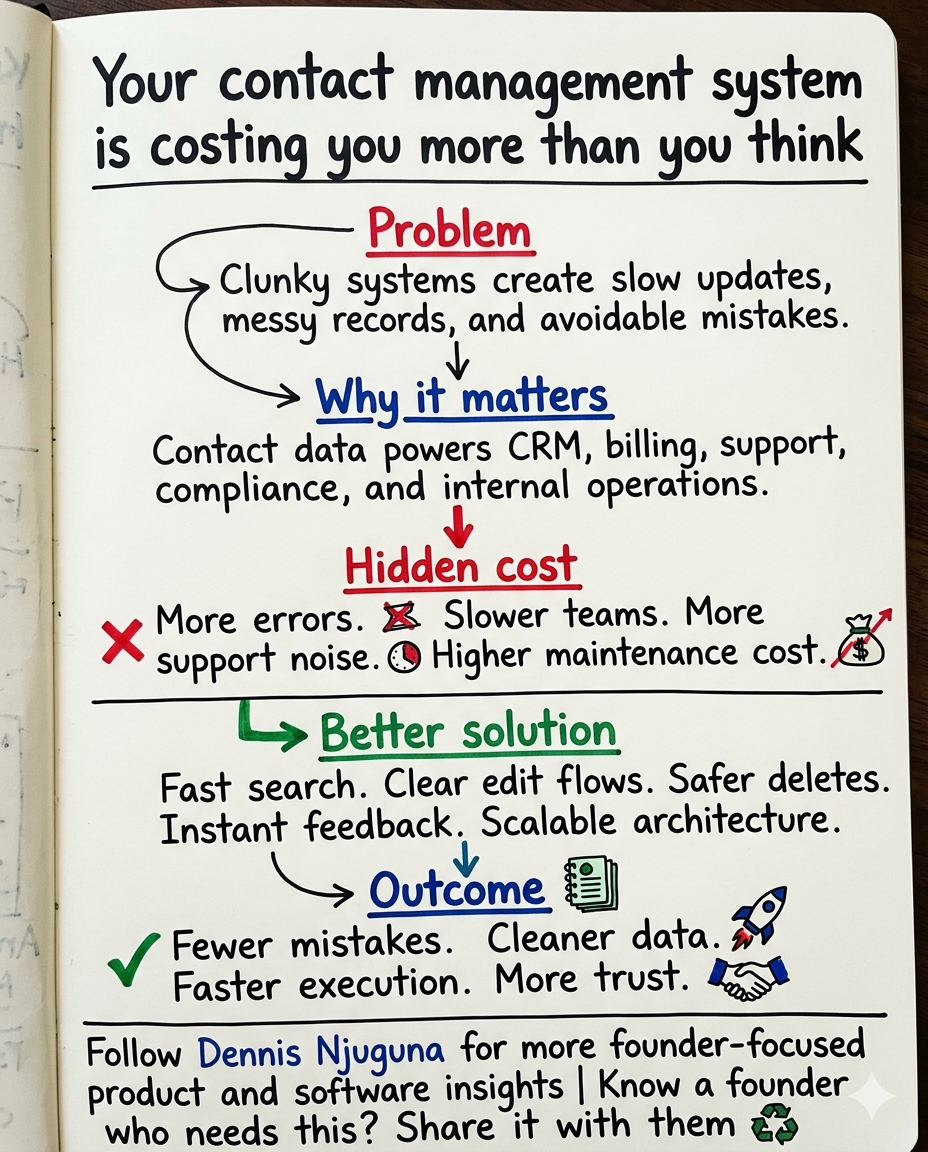
The bigger point
Contact management is not a basic feature.
It is part of the operating system of the business.
And when the operating system is built well, people move faster, make fewer mistakes, and trust the tool they are using. When it is built badly, the team ends up paying for it in time, errors, and lost momentum.
That is why I build software this way.
I help founders build scalable, production-grade software that supports growth, including the internal systems that teams rely on every day.
If your contact management software is creating friction, that friction is costing you more than you think.
Share this article
Send it to someone who would find it useful.