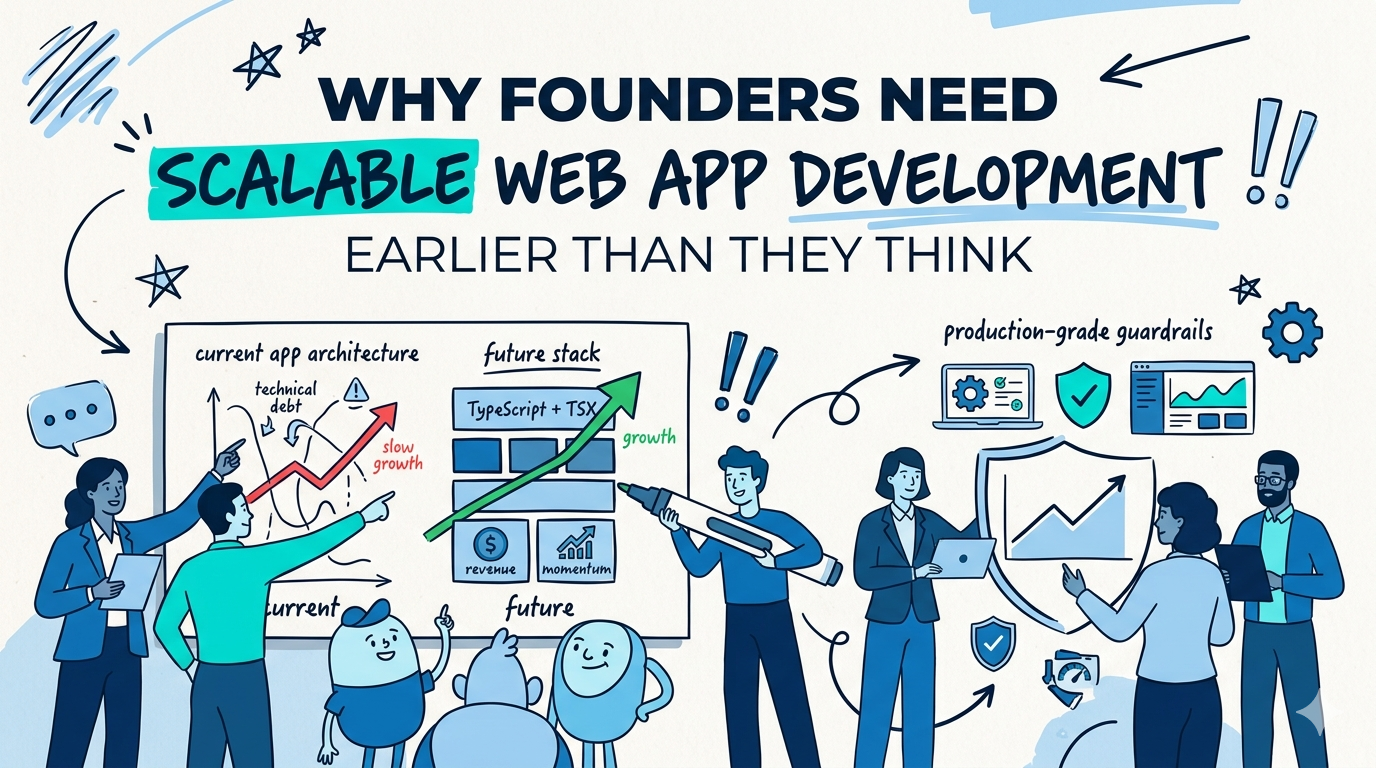
Your web app can look finished and still be the thing quietly making growth harder.
That’s the part many founders don’t see at first.
On the surface, everything looks fine. The product is live. Customers can sign up. The dashboard works. The team is shipping. From the outside, it feels like progress.
Then the cracks start showing up in places that are harder to explain.
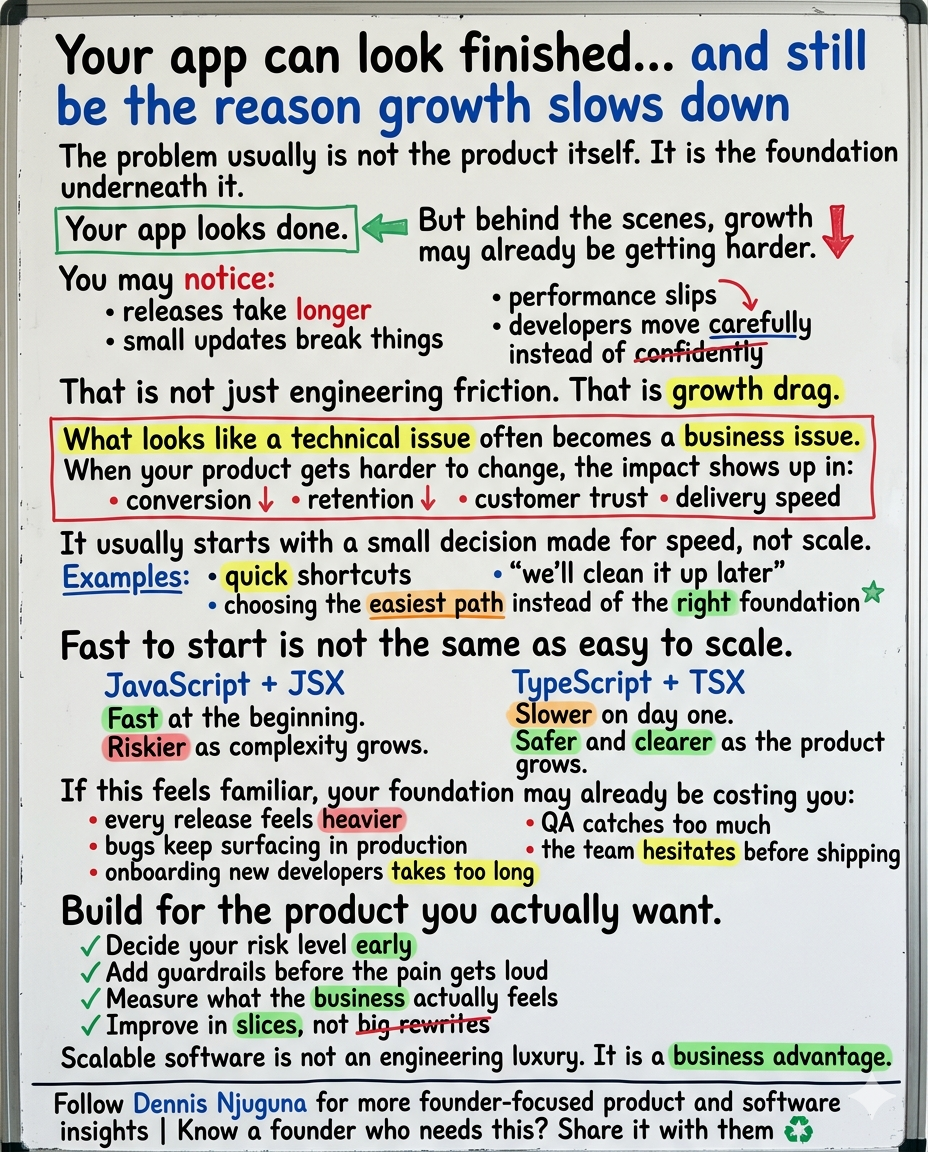
Releases take longer than they should. Small changes break unrelated flows. Performance gets inconsistent. Developers spend more time navigating the codebase than improving it. What used to feel fast now feels fragile.
And suddenly, the product that helped you get traction starts resisting the next stage of growth.
That is exactly why scalable web app development matters.
Not because it sounds more technical. Not because it looks good in an architecture diagram. But because when your software is not built to support growth, the business feels it long before the team calls it a technical problem.
Founders usually feel the problem before they can name it
Most founders do not wake up thinking, “We have an architecture issue.”
They think:
- Why are releases slower now?
- Why does every feature take more coordination?
- Why are performance complaints showing up more often?
- Why does the team seem careful instead of confident?
Those are business questions.
But underneath them, there is often the same root issue: the product was built to launch, not to scale.
And the market is less forgiving than it used to be. Google says Core Web Vitals are used by its ranking systems and recommends sites hit strong thresholds for loading, responsiveness, and visual stability: LCP within 2.5 seconds, INP under 200 milliseconds, and CLS below 0.1.
The problem is that most sites still are not there. The 2025 Web Almanac found that only 48% of mobile websites and 56% of desktop websites achieved good Core Web Vitals.
That matters for more than SEO. It matters for user trust.
And speed still has a measurable business effect. In Deloitte’s mobile performance study, a natural 0.1-second speed improvement correlated with 8.4% higher retail conversions, 9.2% higher average order value in retail, 10.1% higher travel conversions, and an 8.3% improvement in bounce rate on lead-gen information pages.
So when a founder says, “The app works, but growth feels heavier than it should,” that instinct is often right.
Scalable web app development is really about reducing expensive uncertainty
A lot of teams think scaling is mostly about servers, infrastructure, or traffic.
That is only part of it.
Real scalability is about whether the product stays reliable and changeable as the business gets more demanding.
Can your team ship new features without fear?
Can new developers be onboarded without weeks of tribal knowledge transfer?
Can you improve performance without triggering regressions somewhere else?
Can your product handle more users, more complexity, and more revenue-critical workflows without slowing the company down?
That is why I define scalable web app development more simply: It is the discipline of building software that can grow in traffic, team size, product complexity, and business importance without becoming fragile.
That sounds obvious. But most teams do the opposite by accident.
They optimize for the fastest possible start.
Then they spend the next year paying interest on that decision.
The early stack decision that most teams underestimate
This is where the JavaScript vs TypeScript conversation becomes useful.
Not because every founder needs to become opinionated about syntax.
But this choice reveals how a team thinks about tradeoffs.
The current developer market tells an interesting story. Stack Overflow’s 2025 Developer Survey, based on more than 49,000 responses from 177 countries, found that JavaScript remained the most-used language at 66% overall, while TypeScript reached 43.6% overall and 48.8% among professional developers. In the 2024 survey, TypeScript was at 38.5% overall and 43.4% among professionals.
That does not mean TypeScript is automatically the right choice for every project.
It does mean typed workflows are no longer niche. They are mainstream enough that founders should stop treating them like “extra engineering ceremony.”
Because the real tradeoff is not “JavaScript is fast, and TypeScript is slow.”
The real tradeoff is this:
- JavaScript often helps you move faster at the beginning.
- TypeScript often helps you stay faster as the codebase grows.
That distinction matters.
If you are building a disposable prototype, JavaScript may be enough.
If you are building something that touches revenue, customer data, retention, or internal operations, the cost of ambiguity goes up quickly. In that environment, clearer contracts, safer refactors, and easier onboarding are not nice-to-haves. They are operating leverage.
The hidden cost is not bad code. It is a drag.
Founders sometimes hear “technical debt” and tune out because it sounds abstract.
It is not abstract when it starts changing delivery speed.
McKinsey has described tech debt principal as accounting for up to 40% of IT balance sheets, with many companies paying more than 10% interest on projects in the form of friction, rework, and complexity.
At enterprise scale, the waste gets dramatic. Pegasystems reported in 2025 that the average global enterprise wastes more than $370 million a year because it cannot efficiently modernize outdated legacy systems and applications.
Even before a company reaches that size, the pattern shows up in team productivity. Atlassian’s 2025 State of Developer Experience survey, based on 3,500 developers and managers across six countries, found that 50% of developers lose 10+ hours per week to non-coding inefficiencies, 90% lose 6+ hours, and developers spend only about 16% of their time actually coding.
That is the founder's version of technical debt
Not “our code is messy.”
But “our team is working hard and still losing momentum.”
What founders should do instead
This is the part that matters most.
You do not need to over-engineer everything on day one.
You do need to stop pretending all software decisions are equally reversible.
Here is the practical way to think about it.
1. Decide your risk level before you decide your stack
Ask a brutal question early: Is this a throwaway experiment, or is this becoming a product line?
If it is a real product expected to scale this year, treat it like one sooner than it feels convenient.
That means you make stack decisions based on lifespan, team size, and business criticality, not just on what feels fastest in the next sprint.
2. Default to more structure when the product matters
For a solo experiment or very short-lived MVP, JavaScript can be fine.
For a team-owned, long-lived, revenue-connected product, defaulting to TypeScript is usually the more defensible move.
Not because TypeScript is fashionable.
Because ambiguity gets expensive as systems grow.
3. Put guardrails in place before the pain gets loud
This is where scalable web app development separates itself from “we’ll clean it up later.”
Guardrails include:
- stricter typing over time
- shared component patterns
- linting and formatting
- CI checks that block risky merges
- test coverage around critical paths
- performance budgets and monitoring
- observability for production issues
DORA’s 2025 research is useful here. It found that AI can improve throughput and product performance, but it can also hurt software delivery stability if teams do not have strong foundations. Their conclusion was blunt: AI does not fix weak teams; it amplifies what is already there. They specifically call out strong automated testing, mature version control, and fast feedback loops as the controls that help teams benefit without increasing instability.
That lesson applies even if AI is not the center of your workflow.
More speed without stronger guardrails just creates faster chaos.
4. Measure the business outcomes, not just engineering output
If you want the software to support growth, measure what growth actually feels like inside the product.
Track things like:
- page responsiveness
- signup completion
- checkout completion
- production error rates
- rollback frequency
- release confidence
- time-to-fix for critical issues
Google’s own guidance is a reminder that performance is not just technical hygiene; it is part of the overall page experience that their systems look to reward.
If you do not measure experience, you will end up debating it.
5. If you are already deep in JavaScript, do not rewrite everything
This is where founders often make the wrong recovery move.
They realize the product needs stronger foundations and jump straight to “We need a rewrite.”
Usually, you do not.
A rewrite can reset momentum, distract the team, and delay the business.
A better path is migration by slices:
- start new modules in TypeScript
- type the edges first: APIs, forms, auth, billing, and reporting flows
- tighten TypeScript rules over time
- clean up the highest-risk hotspots first
- keep shipping while you improve the foundation
That is almost always the more mature move.
The founder takeaway
Your web app does not have to crash to become a growth problem.
It only has to become slower to change, harder to trust, and more expensive to improve.
That is why scalable web app development is not a luxury for “later-stage” companies. It is a strategic advantage for founders who already know the product needs to carry more weight this year than it did last year.
If that is where you are, the right question is not: “Can we keep shipping?”
It is: “Can we keep shipping without quietly increasing risk, drag, and fragility?”
That is the real dividing line between software that supports growth and software that starts taxing it.
If your product is live, growing, and starting to feel heavier behind the scenes, this is usually the right moment to fix the foundation before the cost compounds.
Share this article
Send it to someone who would find it useful.